What Godlike Beings Created the Ryūha?
How were ‘complex pattern drills’—kata—really created? Were they, each and every one, bequeathed by kami, tengu, or other revelation to solitary individuals? Having developed kata for my own ryūha, [reviving kata no longer practiced, but remaining in ryūha documents; revising kata from the form they were in when transmitted to me; creating new kata as well], I know I could not have accomplished much by myself. I engaged in this process with my teachers, and I’ve continued to do this with my peers and students. To be sure, individuals went in isolation for ascetic training, but the creation of two-person complex pattern drill sequences requires more than one person, whether enacted by co-equals, or assisted by nameless disciples.
A good example of this is my recent work with my training brother, Bruce Bookman. Over the course of almost six years, we have been creating and developing two sets of kata, five for a five-shaku staff, and five for swords. We set ourselves a very difficult task because we intend these forms, executed in different ways, to serve both his aikido students and my Araki-ryū (as well as contributing to the curriculum of a different group, Yabe-ryū jujutsu)–the same kata, executed in three different ways. In a sense, we use the same chassis, but different engines.
Yet even two are not enough. Bookman and I test and retest these forms, and we believe ourselves to be honest in what we are doing. However, we have bias’—we only see from the point from which we see. What we have found is that our students each express power differently, move differently, and react differently. When I have worked on these nascent forms with several of my own powerful students, things I thought would work . . . don’t.
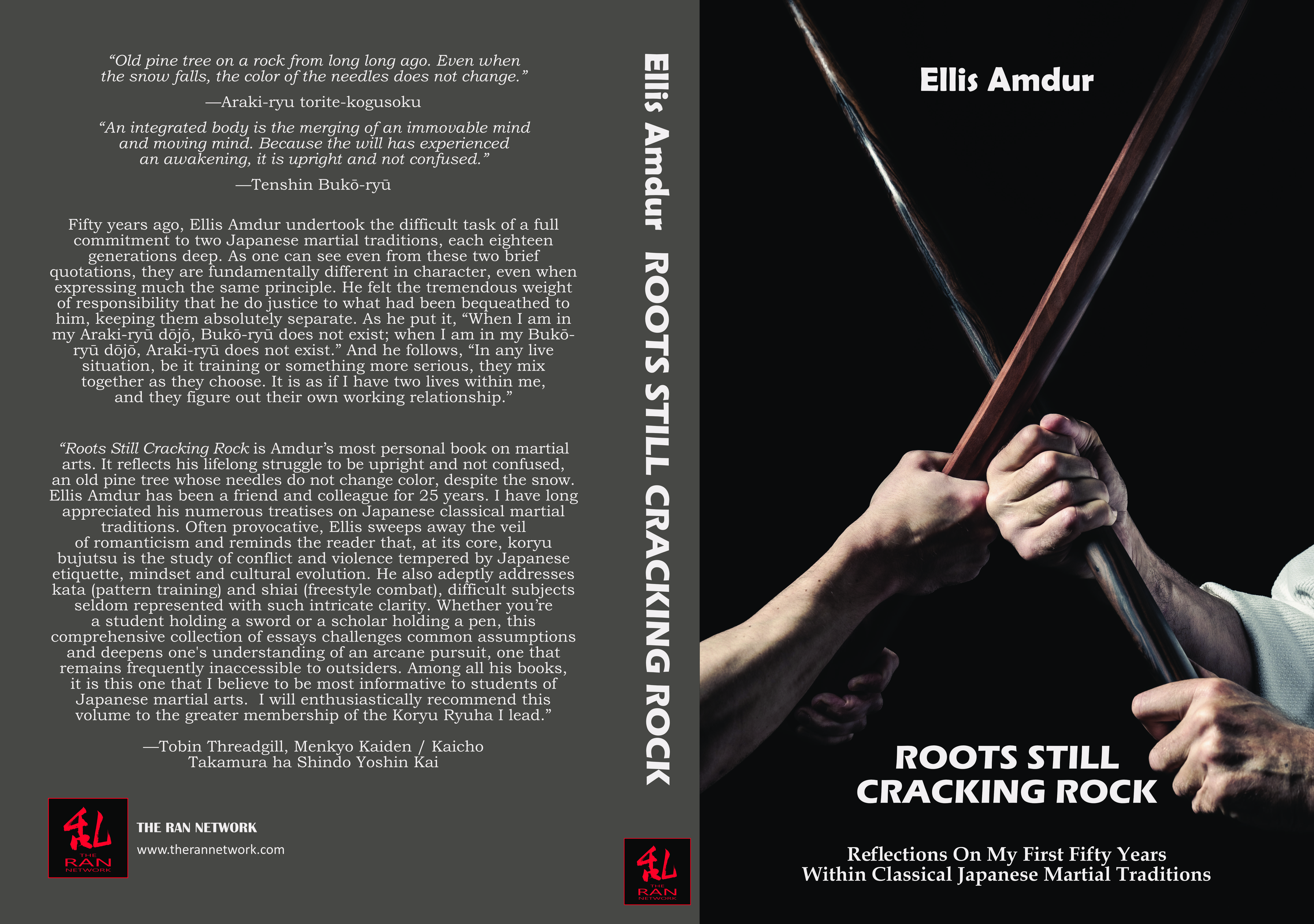
This essay is one of many that has been revised to make the writing itself more graceful, but more importantly, to incorporate my own developing perspective on this subject. It is now part of my new book, Roots Still Cracking Rock: Refections On My First Fifty Years Within Classical Japanese Martial Traditions, which in addition to revised essays from this site, contains new work as well.

fred veer
Very interesting article. The kata you created with Bruce Bookman sound very interesting. Will you publish the aikido version of these ?
Ellis Amdur
Eventually we will. When we are fully happy with them.
Wayne Muromoto
Ellis,
once again, a very thought-provoking essay. Forgive me if I repeat myself, and we may have discussed this before (I am getting really forgetful in my old age!) but…the article brings up some interesting points I have been mulling over. My line of Takenouchi-ryu, the Bitchuden, had accreted a couple of other ancillary ryu in its Kurashiki location over the centuries. My teacher said, back when he was a student, it was all “bujutsu,” and the teachers didn’t make much differentiation other than saying what ryu it came from, originally, just as a matter for the division of collections of techniques. He and his teacher, the current and past soke, have tried to organize the hundreds of kata in the Bitchuden line in order to make sense of them and to preserve and pass on the methods properly.
Well, more to the point: there is a set of iai from the Shizen-ryu. Here is where it gets interesting as far as development of kata geiko and the rise of bugei ryu in Japan. Technically, if one takes apart the Shizen-ryu iai, it appears to be much older than even the mainline Takenouchi-ryu, which is considered one of the oldest surviving bugei ryu, at least in Western Japan. The odd thing about it is that some of the “matters” (Such and Such No Koto; not Such and Such No Kata) are just that, oral “matters.” In one form, we actually do a preset series of movements. In another, it’s just a piece of verbal advice, with some informal sword waving: “When you’re fighting chest-deep or more in a river or ocean, here’s how you stab the guy.” It’s kind of like a rudimentary show and tell. Then you get to the Bitchuden line’s own strain of iai, which is maybe not as old, and its techniques are almost as “weird” (for me, coming from a very formal iai system like Muso Jikiden Eishin-ryu). But at least for every “matter,” you have an organized set of movements. Still, the kata are not as rigidly formalized and there are lots of kuden attached to them, as if the stylisms of the forms were somewhat less important than the kuden that underpins them. And finally, the honke (main) line Takenouchi-ryu, which is very finely organized, with precise physical methodologies. I interpret the differences as a kind of tracking in time of how kata in a ryu developed, from extant very old systems to more formalized ones, in layers and layers and newer and newer ryu.
The explosion of kata as a form of passing on methods coincided with the formalization of many of Japan’s arts and crafts traditions, like tea ceremony. (Prior to Sen No Rikyu, and even a while after his death, I (and some master teachers I have talked to) suspect chanoyu was not as highly structured as it is now. Rikyu gave play to the highly formal but relatively few forms (temae), added more, and then his successors formalized them and added scores more as part of the accretion process, and of course, practically speaking, to be part of the Iemoto-Seido way of certifying their followers (and making a living). So I suspect that kata as an organizational teaching method in bugei training was affected somewhat in that critical formative period. You start with something simple, general, and for a while you play around with it, jiggle it, see how it works, change and modify it. Then it gets set in stone. The Edo Period was the “stone-setting” period for tea ceremony, and I suspect it also affected how the various ryu settled into their own precise kata forms as well.
Another thing mentioned by my teacher (I might have mentioned this once, too…so forgive me if I am repeating it) is that he feels the greatest innovation of the Takenouchi-ryu and subsequent ryu may not have been so much a new or revised technique, and it may not have even been the concept of two-person kata geiko. He said, thinking about it, how in the world did Takenouchi Hisamori learn the first five methods of kogusoku from the Tengu Yamabushi if it was just two beings, him and the Tengu? How could he see what the Yamabushi was doing sometimes during the kata, and if he was doing it wrong when he tried to mimic the movements? No, Ono Yotaro conjectured, the innovation was on how kata and the teaching process was passed on. You needed a teacher, like the Tengu Yamabushi (or Tarobo, the master of the Tengu, the incarnation of Atago Daigongen). And you needed at least one of his assistants (Jirobo). Tarobo would be a “sensei,” and observe Jirobo and Hisamori go over a two person set. How many people do you need to start a ryu? In the case of Takenouchi-ryu, you need three. One to see the overall progression, make corrections, oversee what’s going on and elicit changes. Two to partner off and have at it. So, my teacher conjectures, although not explicitly stated in most widely distributed sources, he felt there were at least two Tengu that appeared to Hisamori because the “new” way of teaching kata in a ryu meant you needed a teacher, a sempai and another student.
Ono sensei’s opinion is that the greatest innovation of the Takenouchi-ryu, therefore, may not have been its technical development in close-quarter grappling with weapons, but in the pedagogical (or as an acquaintance would quickly correct me and say, “NO! ‘androgogical’!) method of teaching and passing on a tradition. Ideally, you would need a teacher, a sempai (who you can mimic, and who you can partner off in two-person kata sets), and yourself, as the person who is trying to have the forms instilled in you. It follows that the teacher can also participate, taking turns with his two students, and in the case of creating or modifying a kata, hash things out and see how it works with more than one partner.
It definitely dovetails into your belief that the development and refinement of a ryu requires a group to advance itself.
Chris Zell
Wonderful article and thank you for sharing it with us. As you are working to develop or refine a kata, how do you determine success? What constitutes a satisfactory kata in your view?
Ellis Amdur
There are several levels to that question.
1) I (and my associates, whomever they may be) decide that the kata/training drill is worth teaching others.
2) My students always have carte blanche to test what I’m teaching – either by questioning verbally or physically.
3) Therefore, there is an ongoing, never-ending potential for revision of the kata. This is true even with the kata that I was bequeathed by my instructors. Often – usually – the kata sequence is unchanged, but the way of execution is different.
4) At a certain point, I retire. By this, I mean: When I award menkyo kaiden to any of my students, they are free to go their own way. In fact, if they don’t, I would be profoundly disturbed. From that point on, the kata are theirs to do as they wish. If they subsequently invite me back to their dojo, I’m in a ‘grandfather’ role – and any consideration of the kata will be a presentation of what they are doing. This may be, by the way, during us practicing together, and if they do something that I question, I’ll do so physically. But the same applies in reverse.
5) Once I’m retired, in the way I describe, I keep training, but now my responsibility is in breaking new ground for myself – I’ve discharged my responsibility vis-a-vis transmitting the ryu. Again, I may offer what I’ve discovered to my (former) students, but it is in the capacity of a ryu elder, not a dojo teacher.
I know that this is at variance to the interpretation of a koryu as an intangible cultural treasure, that should never be (consciously) questioned. That it is unconsciously questioned is shown when you peruse a ryuha on film over three-four-five generations.
Returning to your question – a ‘satisfactory’ kata – it must be fully congruent with the ryuha, to its core. I’ve written this elsewhere, but upon my presentation of five kusarigama vs sword kata which I had revived from old Toda-ha Buko-ryu records, Nitta sensei said, “Chyotto Buko-ryu rashiku arimasen.” This was serious – what she was saying is that, quite apart from whatever merits the kata might have, they were not Toda-ha Buko-ryu. I spent over a year reworking the forms, referring to our entire curriculum, to the gokui, to . . .everything. When I presented my reworked version, she simply nodded. So, another aspect of this, at least in traditional Japanese martial arts, is that one is true to the paradigms of the specific art.
Joe Bodie
Great article with much food for thought. I’m all for keeping Koryu relevant and effective. Testing under pressure and continual evolution is required to do that, but it brings to mind the “Ship Of Theseus” conundrum. If all of the parts of Theseus’ ship are replaced, is it still the same ship? In other words, if all of the techniques in a Ryu are modified or replaced, is it still the same Ryu? This is just a thought experiment, and there isn’t a decisive answer. I’m just throwing out a brick to entice some jade, as they say.
Ellis Amdur
Joe – That is a fantastic puzzle, isn’t it. One time after one of my teacher’s pontificated that we were doing ‘real combatives,’ unlike all those others, I asked why, then, we didn’t update things with firearms, kata preparations/tactics congruent with the modern law, etc. And he said, “That you would even pose that just goes to show how little a foreigner understands.” And then, years later, he set up training for his kids and their neighborhood friends, and we did exactly that . . . not the guns, 😉 but adapting techniques for what kids would need in a Japanese jr. high school. Those who maintain the perspective of a koryu as an ‘intangible cultural treasure’ have it easier, at least psychologically, because the changes that are made are inadvertent or unconscious (kendo footwork, for example). For those who share my perspective, (few as there are), it’s like tacking a sailboat in the wind . . . examining and challenging things – consolidating and practicing – examining again from other perspectives (are we too focused on ‘dueling’ – one-on-one, challenging that by injecting a third party, or training outside, on rocky ground, etc)., practicing again, challenging again – it never ends, which makes going to the dojo endlessly interesting
Von Ryan
It’s fairly apparent therefore, that the only entity truly able to transmit a kata as originally intended are the creators or close associates. Would it be true to say therefore that koryu kata we learn, (in tomiki aikido, for example, where the pro-genitors, Tomiki & Ohba have left no “detailed manual” are mere artifacts, only useful as guides for exploration and discovery.
As a beginner, I often have a problem reconciling differing explanation from different sensei but have learned now to accept this, as a method to build up a knowledge-base using on a legacy framework.
Ellis Amdur
Von – I do not disagree, but I do not totally agree either. One of the merits of the koryu curriculum is that the gokui of the art are a number of principle-based teachings that should ensure that successors can recalibrate the kata back to their essential goals when they, unavoidably deviate (if they are a. properly initiated b. actually pay attention). As a beginner, you describe your responsibilities properly – at a certain point, one must be equal to or surpass one’s predecessors . . . and at that point, the work I describe should take place [Caveat: as an advanced student, one’s instructor should bring you into that process, as I also describe]. I think that the relationship between Tomiki sensei and Ohba sensei is a paradigm of this.