KogenBudo

Category: Uncategorized Page 1 of 12

Oaths to the Gods: All Too Human

Among the chapters in Old School, is one entitled “Keppan: Blood Vows in Japanese Martial Traditions.” I’m very happy with that chapter, for what it is worth, but I think it is fair to say that I leave the impression that kishōmon were always a solemn rite, one properly accompanied by massing clouds, and lightning flickering on the horizon.

It is certainly true that such an oath could be the assumption of a deep responsibility, but it was also true that they were simply the generic way that one made promises in the Japanese feudal period, similar to those in the West avowing such phrases as “So help me G-d,” “On my mother’s grave,” or “On my children’s lives.” Sometimes it had as little weight as a “pinkie swear.” I recently discovered a pledge by a cadre of young bushi, members of a faction of Araki-ryū that reveals a far more human side of things.

Guest Blog: From Taking Heads to Taking Hands: Torite in Early Modern Japan: by Chris Leblanc

“If a person is cut down with a sword in front of the compound, chase the assailant down. If he will not hand over his sword you may kill him. Should he surrender his sword, however, hand him over to the magistrates office.”

-1620s Shogunal notice to Tosa domain on duties during incidents in front of their Edo compound.1

The classical martial traditions of Japan, or koryū bugei (古流武藝) – “military arts flowing from the past” – have undergone something of a minor renaissance in the West in recent decades. Seen as distinct from modern martial arts, the koryū bugei are said to preserve the battlefield skills of the Japanese warrior class down to the present day. Specialist scholarship has long demonstrated this is largely an “invented tradition,” and that the reality is more nuanced.2 Certainly warriors of the Sengoku Jidai, or “Era of the Country at War,” practiced fighting techniques, and in the first few decades after the turn of the 17th century, at beginning of the Tokugawa era (1603 – 1868), a culture of musha shugyo (“warrior pilgrimage”) flourished, that entailed engaging in challenge matches, including fatal duels. This largely ended by the mid 17th century when authorities put an end to it. From then on, bushi of status pursued bugei primarily as a means of cultivating warrior identity and character development. There was “increasingly an emphasis on formal gymnastics and disciplined choreography,” where combative etiolation was perhaps inevitable, and roundly criticized in the explosion of commercial print on all manner of subjects at the time. (Dore 1965 p. 151 et al) 3   The persistent discourse on the martial arts as “arts of war” in the parlance of practitioners, and on their well-documented peacetime deterioration on the part of professors, may have obscured a pragmatic approach that still existed: law enforcement.

Some Excerpts & Commentary of a 1916 Document: Concerning Martial Arts In The Aoyama Domain

I recently received a twenty-one page document, dated 1916. It is a magazine article in which the writer, Andō Kizaburō, interviewed shizoku: retired bushi of the Tanba-Sasayama-han (AKA Aoyama domain). I am going to discuss certain information revealed in the document, as well as providing excerpts, framed in quotes. 

  1. The main martial arts promulgated by the domain were heihō (military strategy),  hōjutsu (gunnery and artillery), kyūjutsu (archery), sōjutsu (spear fighting), kenjutsu (swordfighting), bajutsu (horseriding), and jū-bōjutsu (jūjutsu and bōjutsu, which were regarded, more or less, as one entity). 
  2. It is clear that the Japanese were well aware of the encroaching West, long before the “shock” of the Black Ships, the American visit to Japanese ports which opened up the country, despite Japanese wishes to the contrary. Evidence of this is shown in the Aoyama daimyō taking charge of heihō and artillery and amalgamating various ryūha in these two disciplines and establishing Goryūgi Heihō & Goryūgi Hōjutsu: domain-wide schools of military strategy and artillery, supervised by the daimyō himself. “Regarding artillery, according to the official proclamation around March of the 4th year of Kaei, it was specially emphasized as a martial art that young generations must practice, regardless of the hierarchy of rank.”

Aikidō—A First Principles Examination: A Guest Blog Between Josh Gold & Claude AI

Preface

This is my thirty-fifth year of practicing aikidō. I’ve been Executive Editor of Aikido Journal for a number of years and have run Ikazuchi Dojo for over twenty. In that time I’ve fielded a lot of questions — from students, from people curious about the art, from people outside the martial arts world entirely — about what aikidō is actually about. And I’ve heard, just as often, people espouse principles that I find difficult to reconcile with what the technical system actually contains or what the history of the art actually shows.

I should say at the outset that none of what follows comes from disillusionment. Aikidō has been a foundational part of my adult life and it will remain so. I love the practice—the feel of it, the community it creates, the questions it asks of you on the mat and off. It is precisely because I take the art seriously that I think it deserves serious examination. Examining what we actually do, and whether the common claims made about it hold up, feels like one of the most respectful things I can offer the art.

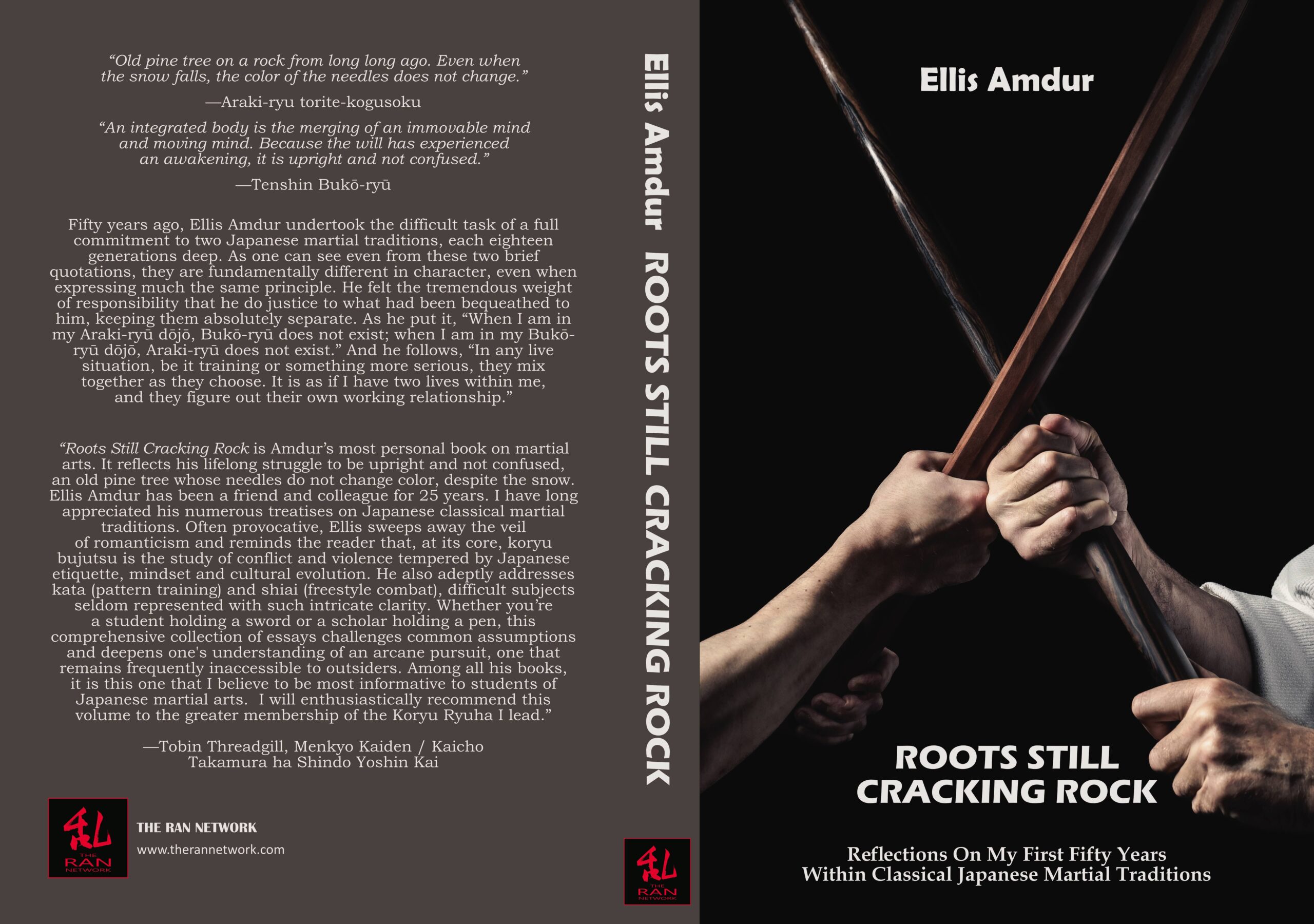
Announcing the General Release of: ROOT STILL CRACKING ROCK: Reflections On My First Fifty Years Within Classical Japanese Martial Traditions

https://therannetwork.com/amdur-roots-still-cracking-rock/

I am pleased to announce the general release of my book, Roots Still Cracking Rock in English, French and Czech.  [Spanish, Italian, and German language versions will be released in the next few months.] This book is my testament to classical Japanese martial arts.


The Arima Onsen Incident

Although this multiple episode story is mostly true, it is also largely unprovable and dependent on men who tended to rewrite their life story every time they told it. So, I will start this story with:

Once Upon A Time

In the early 1910’s, there was a boy who was fascinated by the tairiku ronin, the Japanese adventurers who, often relying on extra-territorial legal rights, raw courage, and a world so violent and strange that it reads like Cormac McCarthy’s “border trilogy:” where trees were festooned with corpses and a blind, degenerate Tibetan ruled Mongolia, where bandits became generals and even rulers of provinces, where a psychopathic Baltic-German Cossack with Japanese among his troops ran amok over Mongolia, striving to create a Buddhist paradise, killing so many that some Mongols still worship him as a God of War, and where a Japanese woman became a pirate queen (This is true! Her exploits, which included taking over an ocean liner, were reported in the Japanese newspapers).

The Essence of Martial Arts

In 1977, thanks to an introduction from Donn Draeger, I began training with Wang Shujin. Here is a video that spans from the  the early 1960’s (black-and-white) to a year before his death (color), when I met him.  We would meet at a temple near Shibuya, if I recall correctly, and in the bitter cold, try to imitate him as he went through his version of the Nanjing Synthesis taijiquan form. This form was created by Chen Pan Ling (here a portion performed by his son, Chen Yun Ching). Wang’s form was very different – he emphasized the elements of xingyiquan and baguazhang that Chen included in this form.

A SOLEMN REMEMBRANCE: In Memory of Quintin Chambers

From Stephen Foster

When a big bell tolls, the sound seems to sink into your soul, affecting you deeply. In the Japanese koryū community the news that Quintin Chambers Sensei had passed most surely had that very same effect.

He trained in judō and aikidō, but when he found the koryū, he became enthralled by it. Quintin was one of the foreign koryū pioneers in Japan that trained under both Shimizu Takaji Sensei in Shintō Musō-ryū (SMR) and Otake Risuke Sensei in Katori Shintō-ryū (KSR). Shimizu Sensei authorized him to instruct in SMR which he did in Hawai’i. He taught the art to a group that always remained small; the required fee was sincere effort and thought about the art.

Page 1 of 12

Powered by WordPress & Theme by Anders Norén