古現武道

KogenBudo

Aikidō—A First Principles Examination: A Guest Blog Between Josh Gold & Claude AI

Preface

This is my thirty-fifth year of practicing aikidō. I’ve been Executive Editor of Aikido Journal for a number of years and have run Ikazuchi Dojo for over twenty. In that time I’ve fielded a lot of questions — from students, from people curious about the art, from people outside the martial arts world entirely — about what aikidō is actually about. And I’ve heard, just as often, people espouse principles that I find difficult to reconcile with what the technical system actually contains or what the history of the art actually shows.

I should say at the outset that none of what follows comes from disillusionment. Aikidō has been a foundational part of my adult life and it will remain so. I love the practice—the feel of it, the community it creates, the questions it asks of you on the mat and off. It is precisely because I take the art seriously that I think it deserves serious examination. Examining what we actually do, and whether the common claims made about it hold up, feels like one of the most respectful things I can offer the art.

There are questions worth asking. Are we communicating about aikidō in ways that are accurate? Are there assumptions or fallacies baked into how we talk about the art that aren’t doing us any favors?

This piece is an attempt to examine those questions honestly—starting from the technical system and the historical record rather than from tradition or reputation. First principles, not received wisdom.

My thinking partner for this exercise was Claude, Anthropic’s AI. I’ll admit I was genuinely surprised by how useful it turned out to be. Claude functions as a capable representative of the collective knowledge and opinions the internet holds about aikidō—which made it an effective sparring partner. I asked it to lay out the commonly articulated principles of the art, pushed back on most of them, and proposed alternatives grounded in the technical system. Claude synthesized the exchange. What follows is that summary, refined through several rounds of back and forth.

The refutations and the alternative framework came from my personal experience with the art—and from a refusal to reach for explanations that don’t hold up against the technical system, the training methods, or the actual historical record. On the hazards of divining what the founder really meant, Ellis Amdur has said it better and funnier than I could here.

This examination focuses on the technical system and the historical record. If your practice is primarily a spiritual one, and you don’t need it to connect to what the technical system actually delivers or what history actually shows, the questions raised here may simply not concern you.

This isn’t a definitive take. It’s an alternative one, offered in the hope that a clearer and more honest account of what aikidō is might serve the art better than the philosophy it has inherited.

Josh Gold

Chief Instructor, Ikazuchi Dojo Executive Editor, Aikido Journal CEO, Budo Accelerator

The Commonly Articulated Principles

Aikidō is typically presented to students and the public through a set of philosophical claims that distinguish it from other martial arts. These are worth stating clearly before examining them:

  1. Protection of the attacker—Techniques are designed not to harm the attacker, but to neutralize the threat while leaving them uninjured.
  2. Creating harmony out of conflict—The name itself (ai: harmony, ki: energy, dō: way) suggests the art is fundamentally about resolving conflict without opposition.
  3. Musubi—connection—The practitioner trains to sense and connect with an attacker’s intention the moment contact is made.
  4. Budō as a path of peace—The founder, Morihei Ueshiba, presented aikidō as a path of harmony and reconciliation. This has been interpreted to mean the art is fundamentally peaceful in nature.
  5. Non-resistance—Rather than meeting force with force, the practitioner blends with and redirects attacking energy.
  6. Ki as unified energy—Relaxed, extended energy is more effective than brute strength. This principle is examined more closely in what follows.

These principles are widely used in aikidō culture and marketing. Several of them, however, do not survive close scrutiny.

Refutations

1. Protection of the Attacker

This principle claims the techniques are designed around attacker safety. The technical reality says otherwise. Most aikidō techniques end in either a throw onto the ground or a rapidly applied joint lock targeting the wrist, elbow or shoulder. Against an untrained person, a hard kotegaeshi or shihōnage, applied at speed, would in most cases break a wrist or dislocate a shoulder. The throws are an even bigger problem—many of aikidō’s core throws send uke head first toward the ground. Against an untrained person who does not know how to take ukemi, these are potentially fatal techniques. These are not outcomes consistent with protecting the attacker.

The standard defense—that a skilled aikidōka can control the level of force—is weak. Techniques are trained to the point where uke complies, not where nage controls, and under stress a practitioner will use what they have drilled rather than what they theorize about.

By contrast, Brazilian Jiujitsu, which makes no claim to protect attackers, actually delivers more genuine attacker safety in practice. The mount, back control, and body triangle truly immobilize without requiring injury. A rear naked choke can render someone unconscious without permanent harm. BJJ’s technical system is more honest on this point than aikidō’s.

Verdict: Not a genuine technical principle. At best, an ethical aspiration poorly supported by the technical system as trained.

2. Creating Harmony out of Conflict

In its broader sense—creating harmony out of genuine, resisting, unpredictable conflict— the principle is not supported by standard training.

In standard aikidō practice uke is expected to attack in a committed way and fall cooperatively when the technique is applied—essentially going along with their own defeat. This is closer to ritualized dominance with a set outcome than to conflict resolution. It is not creating harmony out of conflict in any robust sense. It is something closer to a simulation of harmony—the appearance of resolution without opposition to resolve. If the goal is to create harmony out of real conflict, then building compliance into the exchange before the technique begins defeats the purpose entirely. The harmony was never earned; it was arranged in advance. Cooperative aikidō practice sets up a winner and a loser before the exchange begins.

In its narrower physical sense, the principle is partially supported. Even in fully cooperative practice, when uke commits genuine momentum and force into a strike or grab, nage must actually blend with that force—read its direction, time the response, and redirect rather than oppose. The intent and outcome are predetermined, but the physical force is real. Learning to harmonize with an incoming physical force, however predictable, does develop a genuine if limited form of blending.

Verdict: Harmony with a committed but cooperative physical force is genuinely trained. Harmony with genuine, unpredictable, resisting conflict is not. The principle is real in a limited technical sense; the broader claim does not survive the training method.

3. Musubi—Connection and Sensing Intent

This principle claims that aikidō trains the practitioner to sense and connect with an attacker’s intention the moment contact is made—to read what is coming and blend with it in real time.

In its broader sense—reading unpredictable intent in real time from an opponent who is actually trying to hit, throw or pin you—the training method makes this almost entirely impossible to develop.

In standard aikidō practice, nage knows in advance what attack is coming. The format is explicit: uke will throw a shomen-uchi, or a katate-dori, or a yokomen-uchi, and nage will respond with a specific technique. The attack is announced, agreed upon, and often visually telegraphed before it arrives. There is no uncertainty about intention because intention has been shared before the exchange begins.

This is not training to sense intent. It is training to execute a response to a known stimulus. These are completely different skills. Musubi in this broader sense—reading an opponent’s intention, weight shift, momentum and commitment in real time—requires that those things be unknown in advance. The practitioner must actually read what is happening rather than retrieve a pre-matched response. The sensitivity developed through cooperative practice, however real, does not automatically transfer to that context—which is the form of musubi that would actually matter in a martial application.

In its narrower sense—developing sensitivity to a connected partner’s subtle cues, weight shifts and intentions through physical contact—the training does develop something real. Connected cooperative practice can build genuine tactile sensitivity. That is a defensible claim and worth acknowledging.

Verdict: Musubi in its narrower sense—sensitivity developed through connected practice—is genuinely trained by the system. Musubi in its broader sense—reading unpredictable martial intent in real time—is not. The training method removes the conditions necessary to develop it.

4. Budō as a Path of Peace

This principle draws heavily on the founder’s post-war spiritual statements. It does not survive examination of his actual life and associations.

The founder had documented close ties to ultranationalist organizations and figures. He accompanied Deguchi Onisaburō on an armed expedition into Manchuria and Mongolia in the 1920s. He trained Imperial military and naval officers and kept close ties with figures connected to Japanese militarism. When asked whether his father was a pacifist, Ueshiba Kisshōmaru—who knew him better than any outside commentator—laughed at the suggestion.

The “path of peace” framing appears to be largely a post-WWII reconstruction, developed primarily by Ueshiba Kisshōmaru as aikidō was repackaged for a Japan emerging from occupation and for Western audiences. It served practical purposes: rebuilding martial culture in a society that needed to move beyond militarism, and making the art attractive to the West. It reflects the son’s project more than the father’s lived reality.

It is also worth noting that harmony, as the founder understood it, does not necessarily imply peace in any conventional sense. Research into Japanese budō terminology reveals that the concept of harmony at the root of these ideas is better understood as social cohesion: order within a group, closer to “putting things in order” than to any Western notion of peaceful coexistence. Crucially, the opposite of this kind of harmony is not war, but chaos. Enforcing order, even through violence, was entirely consistent with this understanding—which makes the founder’s documented associations with militarism considerably less contradictory than they might first appear.

Verdict: Historically unsupported. A retrospective construction rather than an authentic founding principle.

5. Non-Resistance

This principle is partially supported by the technical system—but only on one side of the exchange.

Ukemi training does develop genuine non-resistance. Once a practitioner has been taken to the point of no return in a throw or lock, the only choices are to yield or be injured. Learning to blend, absorb and find the exit pathway rather than fight the inevitable is real training with real physical feedback. In this sense uke develops authentic non-resistance through a practical survival skill—ideally one that generalizes beyond the mat.

What the system does not develop is nage’s ability to apply non-resistance against a genuinely unpredictable, resisting force. Nage’s blending and redirection is practiced against a known, cooperative attack—which removes the conditions under which non-resistance as a real skill would need to function. The principle is half-trained: uke’s side of the exchange gets honest development, nage’s side does not.

Verdict: Genuinely developed through ukemi practice, but only partially supported by the system as a whole. The principle is real; its development is incomplete.

What Survives: Ki as Internal Harmony

The most verifiable place to locate the harmony principle is internal rather than interpersonal. Here the principle describes something real and observable:

  • Remaining supple and centered when grabbed or under pressure
  • Not spiking into panic, aggression or tension when threatened
  • Maintaining ma-ai without anxiety
  • The understanding that a tense, fearful body cannot move efficiently or respond well

This reflects a real mind-body phenomenon. A practitioner who tenses against a grab achieves less than one who stays soft and responsive. When the more mystical claims about ki are set aside, what remains is something like quality of presence and relaxation under pressure—a real training target with observable results.

Central to this is the unification of intent and physicality. In most people under threat, mind and body work against each other—the mind panics while the body freezes, or aggression overrides sensitivity. What aikidō, at its best, trains is the closing of that gap: the practitioner’s intention, attention and physical movement becoming a single coherent thing rather than competing impulses. This is what ki most plausibly refers to when stripped of mysticism—not a supernatural force but the felt experience of being fully present, fully relaxed, and fully committed to a single direction of movement and intent at the same time.

The Martial Frame Is Necessary

If one of the real goals of practice is developing internal harmony—composure, sensitivity, relaxed response under pressure—the martial framing is not incidental. It is essential.

Without a real grab, a strike incoming, a moment of threat, the practitioner is simply moving through air. The martial context creates the conditions under which internal qualities are actually tested and either develop or fail to develop. You cannot develop composure under pressure without actual pressure.

This is a powerful insight about how learning works: the physical threat acts as an honest feedback mechanism. You either stay relaxed and centered or you don’t, and the outcome tells you which.

One way aikidō can be described is as a study of human interaction under pressure, using the martial encounter as its laboratory. The techniques are the medium through which the real curriculum—presence, sensitivity, relaxed response, genuine connection—is delivered and tested.

A First Principles Thesis: Generative Exchange

If we examine what the technical system actually contains — rather than what has been claimed about it—something emerges that is rarely articulated: a framework that may be more internally consistent with the technical system than any of the principles examined above.

Core proposition: Aikidō is a discipline of generative exchange. Its goal is not victory, not peace, and not the absence of conflict. Its goal is ensuring that interactions— including conflicts — produce growth and value for the people involved rather than pure destruction.

This framework maps onto the technical system in the following ways:

The exit pathway. Most aikidō techniques structurally contain what might be called an exit pathway for uke. The throw creates a direction that uke can follow safely through skilled ukemi. The joint lock offers a moment where uke can receive the technique safely rather than resist into injury. Ukemi training—which is central to aikidō practice—is essentially the training of finding and taking these exit pathways. The technique does not force destruction. It offers a choice.

Responsibility shifts to uke. This reframes the attacker protection principle honestly. Nage is not engineering safety for uke. Nage is creating conditions in which uke can choose safety. If uke takes the exit pathway, the exchange continues—they can return, reset, and the practice goes on. If they do not take it, the outcome is on them. This is a more defensible and technically accurate claim than saying the techniques are designed to be harmless.

Conflict is permissible if generative. The framework does not require the absence of conflict. Conflict is acceptable—even necessary—when it results in growth for both parties.

Termination as a legitimate outcome. Not every interaction can be generative. Someone with lethal intent has, by their own action, opted out of generative exchange. In such cases the framework does not require the practitioner to extend the offer indefinitely. Terminating an interaction that cannot be generative—up to and including incapacitating or killing an attacker who presents a lethal threat—is consistent with the framework’s logic, not a violation of it.

The reasoning here is broader than the individual encounter: removing a destructive element from the situation preserves the possibility of future generative exchanges with others. This is internally consistent and avoids the problems of absolute pacifist frameworks, which cannot answer the lethal threat question without requiring a kind of martyrdom nobody actually accepts.

Implications for Training

Standard aikidō practice develops real skills. The question is whether those skills match what people claim the art develops—and what you want aikidō to do for you.

Cooperative drilling has genuine value. It is how technique, timing and body mechanics are built in any serious martial art. The problem is relying on it exclusively without a live component where what was drilled is tested against uncooperative resistance. Aikidō’s technical system was never designed for that kind of pressure testing, and adding it in is not straightforward.

If what attracts you to aikidō are the principles that hold up—developing internal harmony, maintaining composure under pressure, refining sensitivity through connected practice, promoting generative exchange—the technical system genuinely supports those goals. You are on solid ground and the training, practiced honestly, can deliver them.

If what attracts you are the principles we have refuted—creating harmony out of real conflict, sensing genuine intent in real time, or practicing what is genuinely an art of peace rather than a system of ritualized violent encounters with real injury potential—then you have an unsolved problem on your hands. How to develop a training methodology that delivers on these principles remains an open question—one a number of teachers are actively exploring through very different approaches, with encouraging results.

Conclusion

The standard philosophical claims made for aikidō do not all survive scrutiny. The protection of the attacker is not supported by the technical system as trained. The path of peace is a post-war construction that does not reflect the founder’s biography or associations. The claim to create harmony out of conflict is undermined by a training method that arranges compliance in advance.

What survives is something more interesting and more honest: a discipline aimed at developing internal composure and genuine relational sensitivity, using martial pressure as its testing ground, oriented toward ensuring that human interactions—including violent ones—tend toward generative rather than destructive outcomes.

This is a coherent framework, and it is grounded in what the technical system actually contains. Whether it holds up is for practitioners to test on the mat and evaluate for themselves—which is probably how it should be.

NOTE: This essay is published with the kind permission of Josh Gold

Purchase Ellis Amdur’s Books On Budō & De-escalation of Aggression Here

Note: If anyone finds themselves grateful for access to the information in the essays published on this site, you can express your thanks in a way that would be helpful to me in turn. It would be most welcome if you were to purchase one or more of my books, be it those on martial traditions, tactical communication or fiction. In addition, if you have ever purchased any of my books, please write a review – the option is there on Amazon as well as Kobo or iBook. To be sure, positive reviews are valuable in their own right, but beyond that, the number of reviews bumps the algorithm within the online retailer, so that the book in question appears to more customers. 
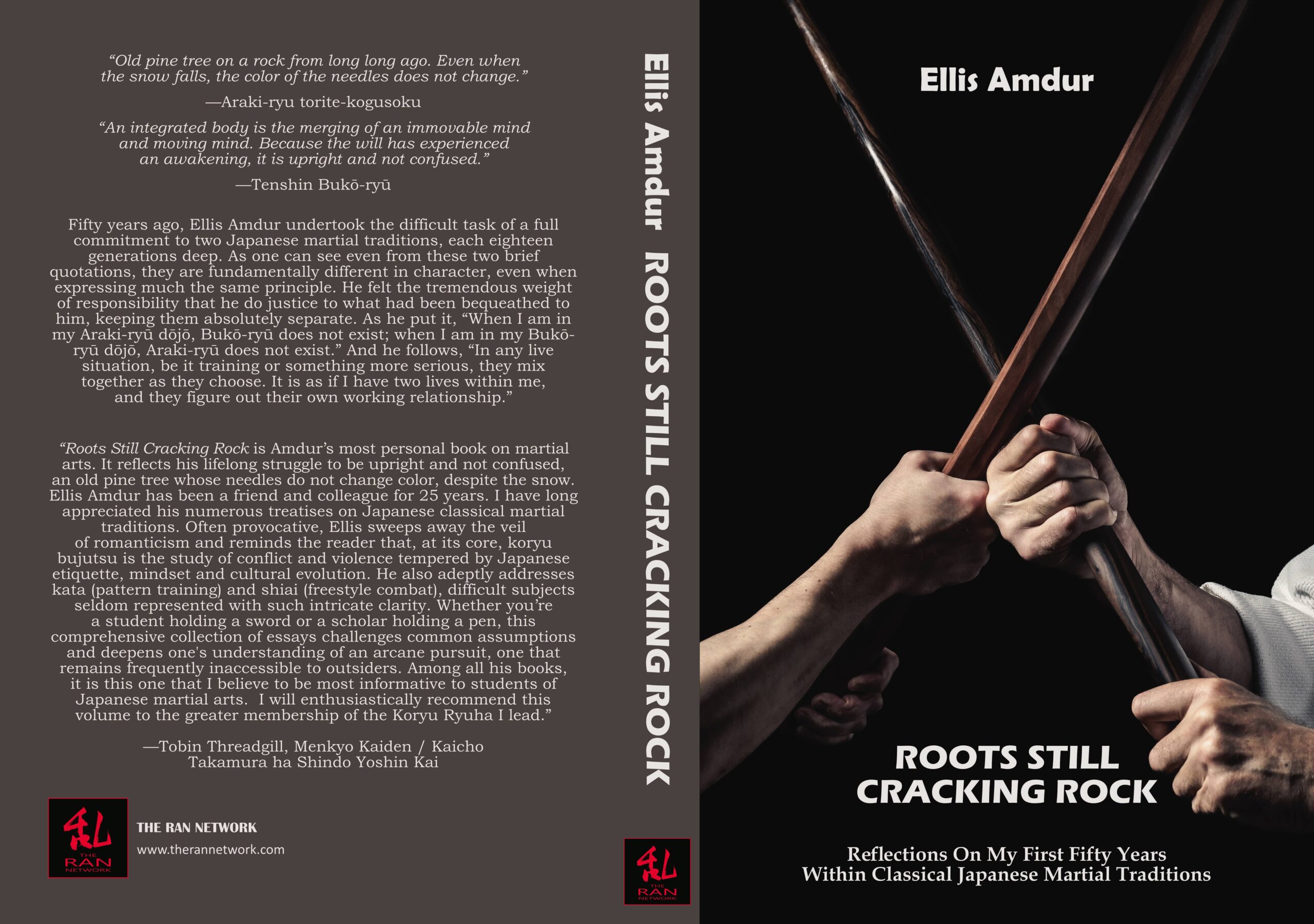
Announcing the General Release of: ROOT STILL CRACKING ROCK: Reflections On My First Fifty Years Within Classical Japanese Martial Traditions

I am pleased to announce the general release of my book, Roots Still Cracking Rock. [French, Spanish, Italian & Czech language versions will be released in the next few months.] This book is my testament to classical Japanese martial arts.

Roots Still Cracking Rock: Refections On My First Fifty Years Within Classical Japanese Martial Traditions


The Arima Onsen Incident

Although this multiple episode story is mostly true, it is also largely unprovable and dependent on men who tended to rewrite their life story every time they told it. So, I will start this story with:

Once Upon A Time

In the early 1910’s, there was a boy who was fascinated by the tairiku ronin, the Japanese adventurers who, often relying on extra-territorial legal rights, raw courage, and a world so violent and strange that it reads like Cormac McCarthy’s “border trilogy:” where trees were festooned with corpses and a blind, degenerate Tibetan ruled Mongolia, where bandits became generals and even rulers of provinces, where a psychopathic Baltic-German Cossack with Japanese among his troops ran amok over Mongolia, striving to create a Buddhist paradise, killing so many that some Mongols still worship him as a God of War, and where a Japanese woman became a pirate queen (This is true! Her exploits, which included taking over an ocean liner, were reported in the Japanese newspapers).

The Essence of Martial Arts

In 1977, thanks to an introduction from Donn Draeger, I began training with Wang Shujin. Here is a video that spans from the  the early 1960’s (black-and-white) to a year before his death (color), when I met him.  We would meet at a temple near Shibuya, if I recall correctly, and in the bitter cold, try to imitate him as he went through his version of the Nanjing Synthesis taijiquan form. This form was created by Chen Pan Ling (here a portion performed by his son, Chen Yun Ching). Wang’s form was very different – he emphasized the elements of xingyiquan and baguazhang that Chen included in this form.

A SOLEMN REMEMBRANCE: In Memory of Quintin Chambers

From Stephen Foster

When a big bell tolls, the sound seems to sink into your soul, affecting you deeply. In the Japanese koryū community the news that Quintin Chambers Sensei had passed most surely had that very same effect.

He trained in judō and aikidō, but when he found the koryū, he became enthralled by it. Quintin was one of the foreign koryū pioneers in Japan that trained under both Shimizu Takaji Sensei in Shintō Musō-ryū (SMR) and Otake Risuke Sensei in Katori Shintō-ryū (KSR). Shimizu Sensei authorized him to instruct in SMR which he did in Hawai’i. He taught the art to a group that always remained small; the required fee was sincere effort and thought about the art.

Guest Blog: Laszlo Abel on Charle Parry, the First Non-Japanese to Train in Daitō-ryū

Notes: From Ellis Amdur
  1. This essay is published with the kind permission of Mayumi Abel
  2. Any additions, clarifications or other changes to Laszlo’s essay, that follows the foreword, will be in oxblood script. I have made minor textual corrections and added a few links.
Forward: Ellis Amdur

Back in the 1970’s and 1980’s, there was a small number of non-Japanese who were training in koryū-bugei. Some such as Phil Relnick, Quintin Chambers, Larry Bieri, Meik Skoss, Hunter Armstrong and the very recently deceased David Hall were closely associated and trained with Donn Draeger, the groundbreaker who proved to many, otherwise chauvinistic, Japanese that non-Japanese could fully integrate themselves within classical Japanese martial traditions (my apologies to anyone I left out of that group). Many others of us were not so closely connected to Donn, but also trained in classical koryū-bugei. Among the most remarkable of them was Laszlo Abel. He was a wiry man of medium height, with a nose that preceded him like the bowsprit of a battleship. He had a hot temper and a rude sense of humor, and I never saw him back down in a debate, even when we were out drinking, and things might turn physical.

Laszlo was interested in the unusual rather than mainstream. I know he trained in a rather obscure branch of Tenjin Shinyō-ryū, Masaki-ryū with Nawa Fumio, Negishi-ryū shurikenjutsu and Shindō Munen-ryū kenjutsu. He had wicked skills with a short chain in his hands, and every time I saw him, he’d reveal some hidden weapon, like a ring, turned inward, that had small spikes on it.

Guest Blog: Spyridon Katsigiannis on “The Russian Martial Art”

After the release of my book, Hidden In Plain Sight, I began corresponding with Spyridon Katsigiannis (Spyros). He was then living in Sweden, teaching physical culture. He later returned to Greece, and we began to meet regularly, during my biasnnual trips there. He taught me some kettlebell technique, and we informally began an exchange in our various training methodologies to develop greater abilities to use the body in martial arts practice. We were becoming close friends, something I find increasingly rare as I get older, and it was a personal loss to me, as well as his many students, when he suddenly died of a heart attack. The only blessing is that, at the moment of his death, he was with one of his closest students, whom he had brought up, so to speak, into manhood. He did not die alone.

Spyros’s martial arts training started with Chinese martial arts. If I recall correctly, he trained in Hung Gar kung fu, did tournament fighting, and then became a coach. He lost interest in fighting and martial arts, per se, in his early thirties, but became very interested in Russian Martial Arts, interested in it more for physical culture.

Guest Blog: The Development of Nakada Shin-ryū by Johan Smits

Pre-War Jiujitsu in Europe

Before the second world war, jiujitsu was taught as an independent system throughout Europe. [1] There was no influence from arts like karate or aikidō; furthermore, jiujitsu was different and separate from jūdō. This jiujitsu may have been a bit stiff, and probably relied more on strength than we are led to believe when we read the books and newspaper articles from that period, but its practice still developed formidable fighters, who fought matches against boxers, wrestlers and sometimes just plain street fighters. Some of these matches were organized, while others were unruly affairs, the result of an impromptu challenge during what was intended to be a demonstration of the art. Jiujitsu had to prove its mettle and the record shows that it did.

Page 1 of 12

Powered by WordPress & Theme by Anders Norén