“If a person is cut down with a sword in front of the compound, chase the assailant down. If he will not hand over his sword you may kill him. Should he surrender his sword, however, hand him over to the magistrates office.”
-1620s Shogunal notice to Tosa domain on duties during incidents in front of their Edo compound.1
The classical martial traditions of Japan, or koryū bugei (古流武藝) – “military arts flowing from the past” – have undergone something of a minor renaissance in the West in recent decades. Seen as distinct from modern martial arts, the koryū bugei are said to preserve the battlefield skills of the Japanese warrior class down to the present day. Specialist scholarship has long demonstrated this is largely an “invented tradition,” and that the reality is more nuanced.2 Certainly warriors of the Sengoku Jidai, or “Era of the Country at War,” practiced fighting techniques, and in the first few decades after the turn of the 17th century, at beginning of the Tokugawa era (1603 – 1868), a culture of musha shugyo (“warrior pilgrimage”) flourished, that entailed engaging in challenge matches, including fatal duels. This largely ended by the mid 17th century when authorities put an end to it. From then on, bushi of status pursued bugei primarily as a means of cultivating warrior identity and character development. There was “increasingly an emphasis on formal gymnastics and disciplined choreography,” where combative etiolation was perhaps inevitable, and roundly criticized in the explosion of commercial print on all manner of subjects at the time. (Dore 1965 p. 151 et al) 3 The persistent discourse on the martial arts as “arts of war” in the parlance of practitioners, and on their well-documented peacetime deterioration on the part of professors, may have obscured a pragmatic approach that still existed: law enforcement.
Formal law codes had, for centuries, addressed various kinds of offenses, both civil and criminal: the Joei Code (1232), among various administrative regulations for matters regarding shrines, temples, lands and civil lawsuits also included processes for handling “crimes of killing, maiming, and wounding . . . serious crimes, such as treason, murder, banditry (sanzoku), piracy (kaizoku), night attacks, robbery, and the like” as well as more conventional beatings, forgery, and “abusive language,” that had a tendency to cause quarrels. (Conlan 2022: 47) This calls to mind what we might today call “disorderly conduct” or “provoking assault.”
The Joei Code and its principles were used as common law in the domains of regional lords (daimyo), or included in their house precepts.4 In 1459, the Ouchi domain published law on the walls surrounding the lord’s mansion, where they could be read by all. They prohibited, among other offenses, “wandering along major roads at night” “sumo wrestling at crossroads,” “taking women on the roadside,” (a reference to prostitution/sex trafficking rather than rape or kidnapping), and “wearing strange clothes, claiming that it is the style of the capital.” (Conlan 2022: 194) These were updated over time and in 1487 expanded, prohibiting carrying “[L]ong weapons (nagagusoku – ‘ referring to glaives (naginata), longswords (odachi), or pikes (yari)’ ), bows, and quivers,” although certain individuals were exempt. Apparently one could not walk with “flutes, shakuhachi, or other instruments” unless close to one’s residence, and there was a problem with “loitering” involving “people leering into the Ouchi mansions.” “Night watchmen” were expected to know the law and enjoined to enforce it, for example, for the crime of killing soft-shelled turtles to use as hawk-bait, “the common rabble (honge no tomogara) if they are seen, or rumored to be, killing turtles, they shall be arrested or cut down at the place where it happened, according to the situation.” (Ibid: 194 -197)
In 1506, in the then-capital (Kyoto), law forbade theft, arson, armed assault, “quarrels,” sumo wrestling (again!), and the troublesome dancing (in the streets). (Berry 1994: 245 ) The Jinkaishu, a 1536 legal code of the Date house of Mutsu Province in northern Japan, codified practices for handling offenses including “violent contests;” or “when crazed drunkards kill people [and] claim inebriation as an excuse;” “cases where people impulsively quarreled, or were crazed at a banquet, and unpremeditatedly killed someone.” And, perhaps particularly interesting, instances where people “claimed that through skill they killed ambushers when in fact they ambushed their rival in a surprise attack.” Behavioral expectations are laid out for lords and retainers involved in violent altercations, assassinations, and other killings, including not abetting or harboring killers, tracking them down, searching locations for them, and capturing or killing them. There were punishments for when offenders were killed inadvertently, when captured suspects did not confess, or when personally performing arrests or cutting people down when there was not proper evidence demonstrating guilt. (Ibid: 206-215 ) 5 After the early years of the 17th century, Tokugawa shoguns began promulgating the Buke Shohatto, Laws for Warrior Houses, codes of conduct, laws, and expectations for the warrior class intended to establish the absolute authority of the shogun’s government – called the Bakufu – over other domains. This was institutionalized in 1635, and from then daimyo were required to follow Bakufu law in enforcement and sentencing procedures, and were periodically checked on to ensure compliance. (Botsman: 15)
Maintaining order was an overriding concern, for “below the peace that was taking place at the national level with no wars there was still a fair amount of violence in Tokugawa society.” (Vaporis 2022: 235) We learn from the Omurochuki (Diary of a Parrot in a Cage), the journal of the low-ranking samurai Asahi Shigeaki (1674 -1718), that some young, unemployed samurai killed for sport and material gain, in what was known as “‘street murders’ (tsuji kiri), passersby were killed with swords and robbed.” (Vaporis 2022: 234-235, 351) 6 At the same time. there was a conscious effort by the warrior government to ameliorate the general image of warriors as fiendish butchers carried over from the Warring States period, and to turn warrior-lords away from ideas of military conquest toward keeping civil order. “‘[T]he way of the warrior’ (budō) should be understood as an ‘instrument for killing evil.” The government “was to use it to ‘purify the realm.’” Warriors were now to be seen as benevolent, serving and protecting the public, as “the Tokugawa judicial system came to place considerable emphasis on what would today be called “victim’s rights.” It was realized that too harsh a system of punishment would interfere with the shogun being seen as a benevolent ruler. “[W]arrior officials in the Tokugawa period combined relatively lax enforcement and a tendency to turn a blind eye to minor infractions with the use of “flamboyant” displays of their own power – to pardon as well as punish. This made it possible to bolster warrior authority with the threat of terrifying punishment on the one hand, while also cultivating the goodwill of the general population on the other, with evidence of official flexibility, restraint, and mercy.” (Botsman: 41-42. 49) 7
As we see in newsfeeds today, turning a blind eye toward petty crimes was not without its downstream effects or its critics. By the 1720s, Ogyu Sorai complained that “houses are broken into everywhere; criminals murder, steal and commit arson; and in the middle of the night they lie in waiting in deserted places to rob people,” and remembered “the days when officials routinely cut criminals down on the spot” while lamenting a “dramatic decline in the warrior’s martial spirit.” (Botsman: 86-87) No social strata was above reproach. In 1747, a mentally unstable Shogun’s hatamoto murdered a man in the toilet at Edo castle. 8 Even daimyo were suspected of terrible crimes, including the lord of Mito domain Tokugawa Mitsukuni, when he was young man. “The Tosa samurai Mori Masana, while traveling to Edo in 1829 reported stories that the retired lord of Wakayama would go out at night with four or five attendants, enter people’s homes, and kill them. He is reputed to have killed hundreds of people this way.” (Vaporis 2022: 351)
Enforcing laws and bringing violators to justice fell to local lords following Bakufu law. In rural areas, village headmen and low-status warriors acted as constabulary; maintaining order, capturing or killing violators, and rounding up vagrants and beggars – a persistent problem that only grew worse over time – and putting down public disturbances and uprisings throughout the Edo period. (Botsman) This included duties during sankin-kōtai, the system of “alternate attendance” at the capital city, Edo, in which lords were required to alternate between a year spent residing in their domains with one in the capital. (Nishiyama 1997) Retainers of individual daimyo were required to staff guard-houses in the samurai neighborhoods of Edo and perform basic policing functions in their jurisdiction. Written guides were produced for warriors staffing neighborhood guard stations (tsuji-bansho ) in “how to handle unusual situations.” These situations included corpses (murders or suicides), violent behavior, altercations and fights in front of samurai mansions, violence and injuries within the samurai residences, and attacks using swords. The expectations and other job duties for the guards were strikingly similar to the kinds of things seen in law and policy for law enforcement today: deserted children (a child under three is “deserted” but an older child is “lost”), fugitives, drunks and vagrants, illegal disposals and dumping, lost objects, unruly or dead horses, rescuing people who had fallen into moats, suspicious characters, accidents on the streets, and jurisdictional matters (for instance if a body is found on the border between two tsuji-bansho, the location of the feet — for men it was the left foot, and for women, the right — determined which jurisdiction bore responsibility). 9
Lower-status warriors were required to train in the necessary skills to fill these roles. Passin noted that upper-class samurai learned swordsmanship, horse riding, and archery “as a form of spiritual training,” while lower-class warriors “were taught jūjutsu, lancemanship, group tactics, and rifle.” (1965 p. 21) Michael Wert, in his study of rural swordsmen also pointed out that “martial arts and swordsmanship were practiced differently by different samurai status groups, with an inverse relationship between cultural capital value and combat efficacy.” High ranking samurai were not compensated for their training and their official schools focussed on swordsmanship to strengthen their warrior identity. In the Kaga Han, low-status warriors were “ordered by the domain to learn staff fighting and grappling (jūjutsu).” These samurai foot soldiers (ashigaru), “who used the arts directly in their duties” received compensation for training and “studied arresting techniques or staff fighting (bōjutsu), skills used in their policing roles.” (Wert, unpublished manuscript: 6-7)
The class expectations relative to “peace officer” duties, and how they changed, were illustrated by Confucian scholar, writer, and politician Arai Hakuseki (1657-1725) noting in his autobiography: “when I was seventeen or eighteen, I accidentally dropped in my father’s presence, a torinawa, a finely wound green cord with a hook at the end used for tying people up, which I was carrying in my bosom.” His father noticed the item and said “Long ago, when I was in office, I used to keep this by me in my flint bag. I thought that if I ordered men to seize and bind some disorderly fellow, they might not have it in readiness. When I retired, I had no further use for it, and I kept it for tying up the cat. It is proper that a warrior should know every part of his duties. However, there are things which a man should or should not do, according to his station. This cord is not something you should keep about your person, and you are old enough to know better.” (Hakuseki, p. 48-49)
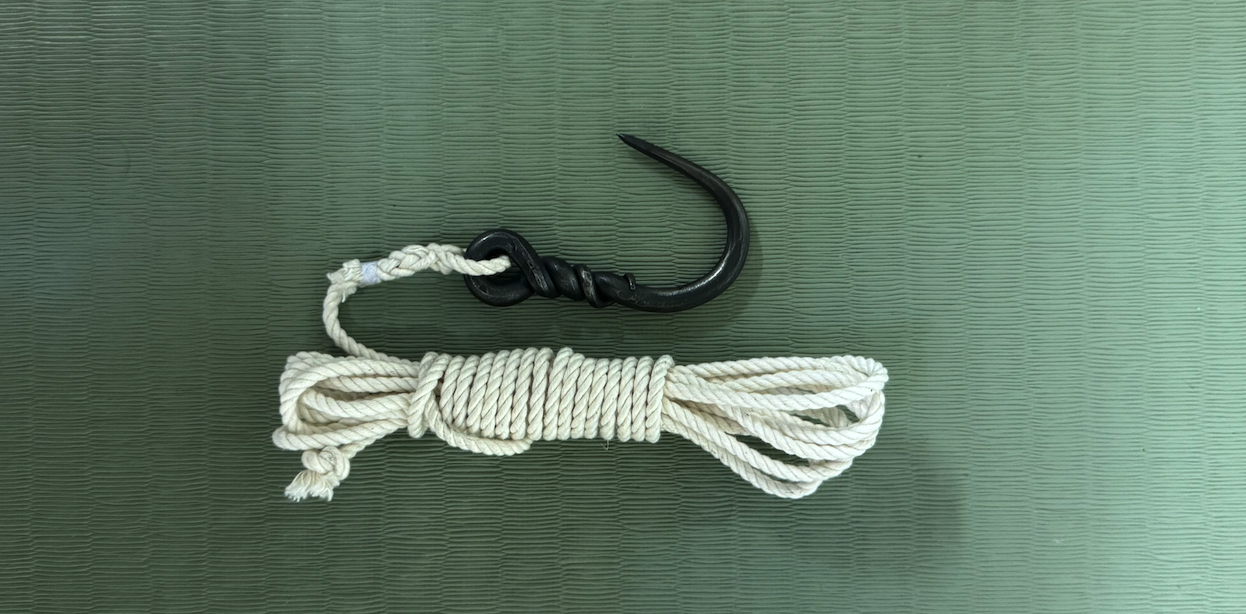 A modern torinawa, also called a kaginawa, or “hook rope.”
It is interesting here to contemplate exactly how, and the reasons why, one might go about tying up a cat….
The Art of Apprehension
Many of the offenders being hunted would be armed, some would have possessed peer or near-peer skills and experience with violence. Some of them were quite desperate. Warriors of known skill were called upon in these incidents, distinct from routine duty, and different tactics evolved for handling what today we call “high risk apprehensions.” For example, in hanachi-uchi, where a retainer would be ordered by his lord to cut someone down based on a crime seen to warrant the use of lethal force, a simple surprise attack might be considered:
“When Tachibana Muneshige (1569 -1642) was just about ten years old, there was a member of his family who had committed a serious crime. Muneshige’s father, Shōun, consequently ordered a certain Hagio to kill him. Hagio met the criminal on the road and slew him with one stroke in the back. Upon hearing about this, some fellow family members were whispering among themselves that killing a man by cutting him in the back was not such a great achievement. But when the rumours came to Muneshige’s ears he said: “On the contrary, closing in on an opponent and not letting him get away with it by making a clear kill, whether you cut him in the front or the back, is a great achievement. If you miss the chance of a good opportunity by choosing the hard way, what would you do if you fail?” 10
Ono Tadaaki (when still known as Mikogami Tenzen ), a renowned swordsman, was sent by Shogun Tokugawa Ieyasu to deal with a situation involving a violent rōnin (“masterless” or unemployed warrior ) on a crime spree in a village called Hizaori. The man was committing murders, robberies, and “assaults on women and girls.” This man barricaded himself in a dwelling – a common occurrence – but came out when he learned a famous swordsman had come to “take his head.” Ono first cut off the man’s arms during an initial attack, but looked to the magistrate that accompanied him for the approval to behead him. It was received, and the sentence carried out tout de suite. (Sasamori 2023: 74-75)
Things could become large-scale and require considerable reinforcements. The Kantō Regulatory Patrol, first formed by the Bakufu in 1805 and given “power to police the entire region” found in 1849 that it needed an additional thousand warriors and five hundred peasants to overcome one heavily armed gang active in the northern Kantō. (Botsman: 107, 128)
Of course enforcement action did not simply mean cutting perpetrators down, especially as the peace continued. Torite refers to techniques for physically controlling a person, including follow-up restraints in the form of rope-binding; it is still part of the curriculum in some classical ryūha today. In the aforementioned Jinkaishu, the word torite refers to an “apprehender” of criminals, not simply a set of arrest skills. (Conlan 2022: 210) Famed swordsmen were also involved in criminal apprehensions. One well known incident – re-enacted in the movie Seven Samurai – involved Kamiizumi Hidetsuna of the Shinkage-ryu intervening in a situation where a man was holding a child hostage. Switching clothes with a Buddhist monk as a ruse, Kamiizumi approached the suspect, offered him food, and when the man moved to take it, Kamiizumi seized him and took him to the ground, rescuing the child. Ultimately the suspect was taken into custody, and was not summarily killed. (Bodiford 2005: 95)
Even Miyamoto Musashi described capture techniques. His Heidokyo, Mirror on the Way of Combat (1604), includes a section on “taking the hand” (実手取りの事) of a man that is “holed up.” He describes a rather involved process, approaching the man with both a spear and holding two swords in one hand with clothing “draped over the scabbard of the shortsword,” apparently as a visual block. Ultimately the swords are discarded after “knocking him flat,” to “tie him up without delay,” while keeping the spear “pressed against his face until he is completely subdued.” (Bennett 2018: 167) As with so many written works in classical schools of this time, this description is accompanied by the words “oral teaching.” With so much going on here, I can’t help but wonder if the verbal instruction for this was to “bring a partner.”
The frequency of barricaded perpetrators comports with my experience in tactical law enforcement – they are common occurrences even today, no doubt due to simple human psychology. In the Heidokyo Musashi advises: “When you know the moment for that one [direct and decisive] strike of jikitsū, let the power surge through you to deliver the cut. It is no different when you enter the opponent’s space to arrest him. Advance rapidly, thinking of nothing other than grabbing hold of him. The further in you get, the better.” (Ibid:169) He touches on it as well in his 1645 Gorin-no-Sho (“Becoming your Enemy” 敵になると云事).
Two hundred or so years later, in Musui’s Story, Katsu Kokichi (1802 – 1850) describes an event from his youth where a samurai named Sakurai argued with a peasant and slashed him, then “stationed himself at the office gate and threatened to slice anyone who came near.” A group assembled to capture him, including some warrior retainers who “were frightened off and stood about wringing their hands,” until Kokichi was summoned to help. An outcast with a six foot pole made a plan with Kokichi, and charged Sakurai, only to be slashed from waist to crotch. But Kokichi threw sand in the swordsman’s face. “Blinded momentarily he lurched forward. The outcaste grabbed him by the testicles and pulled him to the ground. A couple of other outcastes jumped on Sakurai and bound him with rope.” (Katsu 1988: 52-53).
Like the frightened retainers of whom Katsu writes of with evident contempt, many samurai guardsmen did not always perform admirably. Rogers (1998) and Vaporis (2008) detail various professional lapses resulting in investigations and punishment, calling to mind a kind of “Samurai Internal Affairs.” However Botsman writes, “It is worth emphasizing just how few officials were actually involved in ‘policing’ Tokugawa cities. At a time when the population of the capital exceeded a million people, the combined staff of the two Edo town governors consisted of no more than 80 officers and 240 functionaries. Their duties, moreover, were not limited to “policing” alone but included all aspects of urban administration.” To cope with this, officials relied on criminal informants who in turn capitalized on this to commit worse offenses. (Botsman 2005: 87)
The more things change, the more they stay the same
Toritejutsu
There are a number of popular works on Edo period arrest tactics and tools referring to them as taihōjutsu (逮捕術), which appears to be a more modern term. As formal arresting methods, they are a natural evolution from the toritejutsu (捕手術) of the mid-16th century onward, even before the rise of the martial schools that specialized in it. These in turn likely evolved alongside, or were adapted from, forms of close combat with lethal weapons, the taking of heads as battlefield “receipts,” and wartime prisoner-taking. (Amdur 2026)
In that light, torite was not an unarmed art. Beyond lethal weapons it included what would today be called “less lethal” options such as impact weapons, flexible weapons such as chains and ropes, various projectiles, as well as recipes for chemical agents, incendiaries, poisons and antidotes. Tactics for making apprehensions under varying circumstances such as barricaded subjects, how to cross thresholds safely, capturing someone in a bathhouse, on a second floor, in a military encampment, or in water are also preserved in oral teaching and written documents. Torite was quite literally the “special weapons and tactics” of early modern Japan.
Among various ryūha incorporating these teachings are the related schools of Araki-ryū torite and its direct descendent, the now defunct Seishin-ryū yawara.
Araki-ryū
Araki-ryū torite (荒木流捕手) is one of the earliest known systems focused on arresting methods. The founder was Araki Mujinsai Hidenawa (荒木夢仁斎秀綱), and though little is definitively known about him, early sources indicate he was known for his skill at hobaku (捕縛), or “capture and restraining” techniques. Its original catalogue includes torite, kogusoku (close combat with small weapons, especially knives) and restraining methods using rope. Ellis Amdur, quoting a 1916 article by Andō Kizaburō in which he interviewed retired warriors from the Tanba-Sayayama-han, also known as the Aoyama domain, confirms the status-differences in training and expectations that we have already explored. “Because it was an era in which the social class system was strictly enforced, sōjutsu and horsemanship were established as martial arts to be practiced exclusively by those holding qualifications of gokenin (domain samurai) and above. Retainers of the infantry (kachitau) and below did not enter these schools. For swordsmanship and archery, there were no such distinct and definitive restrictions; however, regarding actual practice, there was a general tendency for it to become the domain of the upper-class samurai.” (Amdur, unpublished work, 2026)
In the lower ranks, however, “those referred to as foot soldiers (ashigaru)—for the most part entered training in Araki-ryū and learned the art of capturing (torite). Because these ranks of warriors primarily served in official duties related to guarding and capturing criminals, the study of Araki-ryū was a natural result arising from the operational necessity of their main duties.” although apparently many of the domain’s upper-class warriors (jōshi) also studied the discipline. (Ibid )
Araki-ryū begins with a set of capture techniques involving surprise attack, disarming, and control holds. Distraction and striking are integral. They are harsh methods by today’s standards. When the entire grappling curriculum is understood, it can clearly be seen as adaptations of ambush and assassination methods current when the school was founded. A sense of this might be had by perusing the “sentry removal” and Combatives methods in Chapter 7 of the Army manual FM 21-150 and adapting them for arrest tactics – some of them map almost exactly to Araki-ryū tactics.
In different areas and eras, larger curricula of completely different weaponry were added which had little to do with making arrests, most concerning the integration of standard weaponry of the period: sword, staff, naginata, spear, and chain weapons. However, some lines adapted lethal applications with shorter blades to the use of the jutte (十手), or truncheon, and a short staff similar to the police baton used in public disturbances today. The school generated a number of offshoots, several of which remain in practice today, among them an obscure school called Seishin-ryū.
Seishin-ryū
Seishin-ryū yawara (精神流俰 ) descended from a 3rd generation practitioner of Araki-ryū, Itō Shin’nojō Shigetsugu (伊藤新之丞重次). It was still referred to as Araki-ryū, perhaps for a few generations after Itō, the name changing to Seishin-ryū at the end of the 1700’s. Itō and his successors likely developed it over several generations to the form preserved in remaining documents, as the school itself is now defunct.
Seishin-ryū was primarily associated with the Shōnai Han (Tsuruoka) in modern-day Yamagata Prefecture. It remained relatively insular, without achieving much note, at least in a historical sense as a school of any renown. This perhaps led to its remarkable consistency reflected in remaining documents from the late 1600s to the middle 1800s. Despite its appellation “yawara” – essentially the same as jūjutsu – Seishin-ryū seems to have involved torite-focused elements emphasizing physical restraint, ropes, and other tools suited to a retainer’s security, fugitive apprehension and bandit suppression duties in the domain. (Amdur, private communication, 2026)
Seishin-ryū documents include various kata names, including entire sets, that duplicate or clearly derived from those in Araki-ryū. One extensive 19th century document contains various descriptions of its tactical and technical approach that provides some insight into the school – where many of the teachings in the Araki-ryū originally involved the use of bladed weapons, in the Seishin-ryū they also involve blunt weapons such as truncheons, or jutte (十手/拾テイ). This was a well known tool for Edo period law enforcers, such that the display of one was tantamount to showing a badge, or the flashing blue lights signaling a stop.
Most notable is a section of the Seishin-ryū curriculum that is entitled Araki-ryū dogu no maki, or “Scroll of Araki-ryū tools.” These contain hand drawn illustrations of a set of weapons and capture tools, including a matchlock firearm, but in this context used as a delivery system for Edo period version of pepper spray, incendiaries, even poison gas. There are also rope, impact, and chain weapons including a bola, that remained consistent for nearly two hundred years. The 19th century document noted above indicates “these were handed down by Araki Mujinsai Hidenawa and Mori Kasuminosuke,” however it seems none of these implements are currently preserved in extant lines of Araki-ryū.
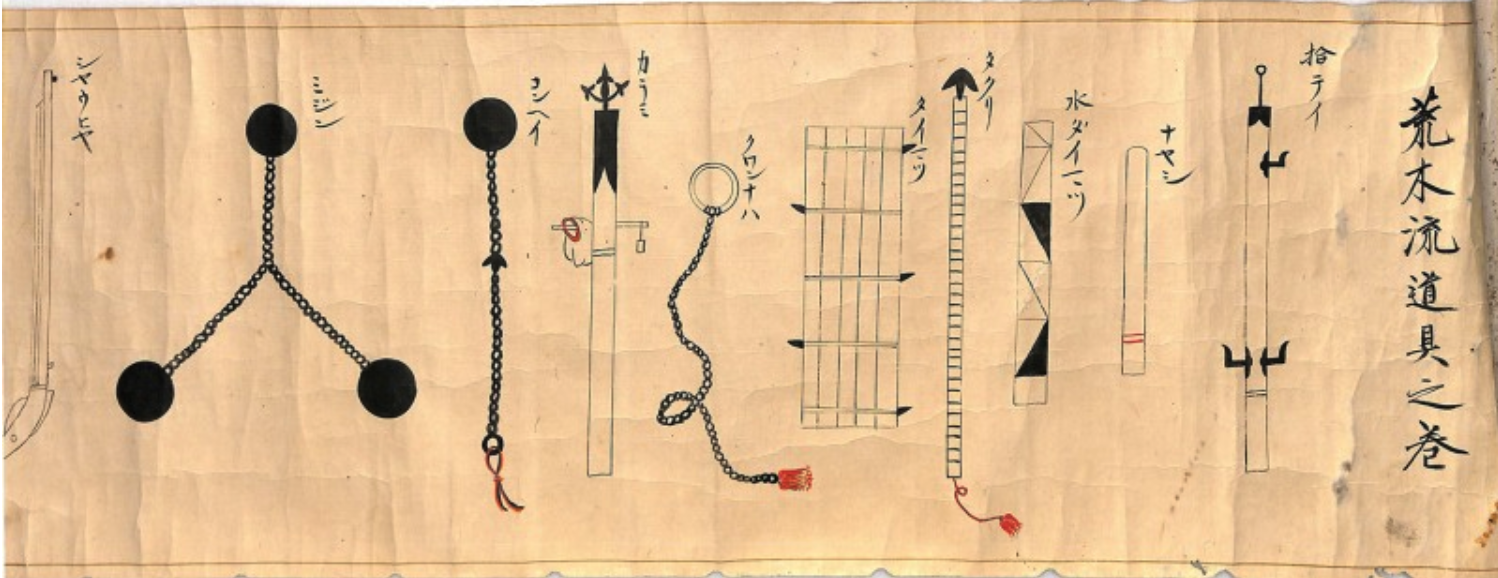 Seishin-ryū’s Araki-ryū dogu no maki
Both Araki-ryū and Seishin ryu also document verbal teachings and transmissions involving the situational tactics, chemical agents, and skills of the torite – the “apprehender.” Many of these weapons and substances and tactics might be seen by layman as “ninja weapons.” In fact an early 20th century ninja researcher published a work duplicating several of the weapons seen above in Seishin-ryū, copying the drawings, and identifying at least one as from Araki-ryū. Rather than fanciful medieval means of “espionage,” they more likely represent what was, for the time, practical means of arresting violent criminals using the technology of the day.
A Practical Analysis: Special Weapons and Tactics
The author here offers some thoughts, based on twenty-eight years service as a police officer, during which I also received coach or instructor certification in several police arrest and control systems and modern close combat methodologies involving firearms and edged weapons, and a long term study of Araki-ryū torite.
I spent twenty-five of those twenty-eight years primarily working “the road:” uniformed patrol, responding to calls for service, conducting investigations, first-responding to in-progress crimes and violent incidents, and making arrests. For a total of more than seventeen of those years I also served on a regional SWAT (Special Weapons and Tactics) team, eventually leaving the team as its senior member and lead trainer for active threat response, arrest and control, weapon retention, and close-quarters shooting.
To give some background, most SWAT teams are collateral duty, so team members work a primary assignment (such as patrol) when not training or otherwise tasked to SWAT for what we called “missions.” When working patrol, we often responded throughout our county, and sometimes the region, to assist with tactical scenes that typically involved stabbings and shootings that “just occurred,” officer involved shootings, high risk arrests of known armed felons, armed barricaded subjects, and sometimes active threat responses. SWAT was typically tasked with serving search warrants for our drug unit (which gradually tapered off over the years), homicide detectives, and for crime reduction units, including the local contingent of US Marshals to which several regional police officers were assigned (often SWAT members). SWAT is called upon due to a greater level and amount of training, higher standards demanded in shooting, decision-making ability, and teamwork, and possessing a range of less lethal and other specialized tools for dealing with different situations, from manual to explosive breaching, “flashbang” deployment, launched and hand-delivered chemical agents (for a time I was one of the main grenadiers for our team), various kinds of ballistic protection, armored vehicles, and more. Of course as working officers we all had Tasers, and SWAT was the primary testing and evaluation body for new technology that pertained to our operations and for dissemination to patrol.
This is my basis for the following analysis and assessment of torite: at least Araki-ryū’s version. While seemingly archaic exercises and not representative of modern reality, the forms do repay serious study. Without going into some of the more esoteric aspects (in terms of mindset – not mikkyo or other esoteric rituals adopted from Buddhism, for readers that might be thinking so), lessons in both tactics and training design are distilled and repeated throughout the patterns of the school. A single platform serves as the foundation for both arrest methods and in extremis personal combat. The importance of this cannot be overstated.
The vast majority of arrests are cooperative, or mostly so. I believe this has been as true across time, in every society with some kind of organized criminal justice mechanism, however rudimentary or primitive. But not all are: and because the person making the apprehension must come into physical contact with their quarry, an opportunity is always present for the suspect to resist, to assault the arrestor with personal weapons (hands, feet, strangles, etc.), to deploy a weapon by ambush to injure or kill, or even to wrest an arrestors weapon away and use it. All control and restraint situations have the potential to instantly turn into a situation where lethal force is a justifiable alternative, something we see play out in newsfeeds today; I have had friends and coworkers assaulted, seriously injured, and killed during arrests, and had suspects attempt to do so to me. All arrests should be approached with situational awareness and tactical readiness, though they cannot be treated as if every single one, or even the majority of them, are a deadly threat.
And therein lies the design genius of the Araki-ryū. Earlier in my career, I was taught “arrest” techniques that were really only effective against minor resistance. Then, completely different methods were shown for weapon retention (retaining a firearm) or ground survival – or combinations thereof. I attended courses on “police” stick and knife-fighting – essentially whichever instructor’s favorite dueling martial art, taught to police with minimal adjustments, despite having virtually no relevance in police work. As the joke goes, everything can be “tactical” if you just add black velcro and patches.
Instead, Araki-ryū is organized for both restraining methods and responses to a sudden attack with a weapon, including to deploy one’s own – using the very same tactics. A small number of foundational movements allow flexibility to respond to the changes of actual conditions is more easily learned and retained, and more robust in use. This serves to streamline training time and reduce the reactionary lag time that presents under pressure when incongruent systems are trained. Hoplologist and senior koryū exponent Liam Keeley called this the Principle of Parsimony, where “it is better to have a few techniques that always work than dozens that only sometimes work, or only work in part,” describing the former as “efficient, economical and integrated across a system.” (Keeley 1999: 138) 11 In my study with Craig Douglas of Shivworks, I found a number of points in common with how Craig organizes and teaches his material.
Working through old documents along with my teacher, it has been fascinating to discover additional methods for the use of ropes, chemical agents and incendiaries, and tactical advice for various situations. While in the Araki-ryū and the Seishin-ryū these are now only part of history, they resonate with my personal experience using similar tools, in similar circumstances, involving all manner of armed individuals. Once again, the more things change the more they stay the same.
Conclusion
Classical schools still teaching torite are a nod to a past body of knowledge, comprising tactics, techniques, and procedures (TTPs if you will), intended for managing armed encounters with violent offenders, with or without “cutting them down.” With minor adjustments when necessary (in some situations no adjustment is necessary), they are still relevant today. Unlike training with swords or spears or any number of other archaic weapons still preserved today, torite has a direct application. Over my career I used it many times and taught it others, I hope taking it from the realm of febrile samurai fantasies, and putting it to cold, practical purpose.
While by today’s standards some of the methods are harsh and quite injurious, they were very much the “less lethal” and “de-escalation tactics” of the times. And while no longer practiced in martial arts schools, many of the tools and substances they used are early versions of today’s tactical armamentarium, giving us a fuller picture of the Art of Apprehension, and insight into how it was conceived and used in the past.
Notes
- Vaporis, 2008, p. 161.
- See Dore 1965, Bolitho 1984, Rogers 1998, Berry 2005, Gainty 2013, Bennett 2015, and Friday 2003, 2018, 2023, among various others.
- See again Dore 1965, Friday 1997 Rogers 1998, and Hurst 1998. Ogyu Sorai went so far as to call the martial practice of the time a “farce staged in a peaceful age,” Ogyu Sorai Kenroku, 1729 (Rogers 1998 p. 150 )
- The Joei Code ends with an oath that was to be repeated from then on in legal and other matters of import in Japanese society. The kishomon of various classical traditions even today includes this oath.
- Incidences involving alcohol were a constant theme, as it appears to have been a serious social problem. See Roberts, 1995. See also this video. . In this light it is more clear why many kishomon – oaths signed on entering the study of a school – included warnings about the overconsumption of alcohol.
- See Tsujigiri, Tameshigiri, and Kirisute-gomen
- Another, more cynical means of accomplishing this was assigning the most brutal kinds of judicial executions to outcastes to perform. Already despised in Japanese culture, this did nothing for their acceptance in society, with effects that still linger today. See Botsman pp. 49-58 for a detailed discussion of this and the intentionality of it on the part of Tokugawa leaders.
- See Murder in Edo Castle
- See IATSUKAI YORAN [How to Handle Unusual Situations] See also Vaporis 2008.
- From Extract from the New Compendium of Samurai Stories (Shin Musha Monogatari, written in 1709) in Yamakoshi and Tsukimoto 2004: 80 Here an application of iaijutsu, quick-drawing and cutting with a sword, is obvious.
- Keeley is a master instructor of Tatsumi-ryū, whose grappling component has a relationship to the Seishin-ryū described above.
References
- Amdur, Ellis Some Excerpts & Commentary of a 1916 Document: Concerning Martial Arts in the Aoyama Domain
- Arai, Hakuseki Told Round a Brushwood Fire the Autobiography of Arai Hakuseki trans. Joyce Ackroyd Princeton University Press University of Tokyo Press 1979
- Benesch, Oleg Inventing the Way of the Samurai: Nationalism, Internationalism and Bushido in Modern Japan Oxford University Press 2016
- Bennett, Alexander trans. The Complete Musashi: The Book of Five Rings and Other Works Tuttle 2018.
- Bennett, Alexander Kendo Culture of the Sword. University of California Press. 2015
- Berry, Mary Elizabeth The Culture of Civil War in Kyoto University of California Press 1994
- Bodiford, William M Zen and Japanese Swordsmanship Reconsidered. Budo Perspectives, Alexander Bennett ed. Kendo World Publications 2005
- Bolitho, Harold “Myth of the Samurai’ in Japan’s Impact on the World. Rix, Alan and Mouer, Ross ed Japan Studies Association of Australia, 1984
- Botsman, Daniel V. Punishment and Power in the Making of Modern Japan Princeton University Press, 2005.
- Conlan, Thomas Donald ed Samurai and the Warrior Culture of Japan 471-1877 A Sourcebook. Hackett Publishing Company Inc. 2022
- Dore, R.P. Education in Tokugawa Japan. Center for Japanese Studies University of Michigan Ann Arbor. 1965.
- Friday, Karl F Afar From Battle: The Japanese Budo Ideal in Historical Perspective. Kampf -und Bewegüngskunste 2023; https://kampfsportmuseum.de/kub/
- Friday, The Way of Which Warriors? Asian Studies VI (XXII), 2, 2018
- Friday, Off the Warpath: Military Science and Budo in the Evolution of Ryuha Bugei, Budo Perspectives Alexander Bennett ed. Kendo World Publications, 2005.
- Friday, with Seki Humitake Legacies of the Sword The Kashima Shinryu and Samurai Martial Culture. University of Hawaii Press 1997
- Fujita, Seiko Ninjutsu Hiroku. Sendai Academy, 1936
- Hurst, G Cameron Armed Martial Arts of Japan Swordsmanship and Archery Yale 1998.
- Jaundrill, D. Colin Samurai to Soldier: Remaking Military Service in Nineteenth-Century Japan. Cornell University Press 2016.
- Katsu Kokichi Musui’s Story: The Autobiography of a Tokugawa Samurai Teruko Craig trans. University of Arizona Press 1988
- Keeley, Liam The Tojutsu of the Tatsumi-Ryu, Murphys Law, and the K.I.S.S. Principle, Sword and Spirit, Classical Warrior Traditions of Japan Volume 2. Diane Skoss ed. Koryu Books 1999
- Nishiyama Matsunosuke, Edo Culture Daily Life and Diversions in Urban Japan, 1600 – 1868 trans. and ed. Gerald Groemer. University of Hawaii Press 1997
- Passin, Herbert Society and Education in Japan Teachers College Press and East Asian Institute, Columbia University, 1965
- Roberts, Luke “A Transgressive Life: The Diary of a Genroku Samurai” Early Modern Japan December 1995 25-30
- Sasamori, Junzo Secrets of Ittō-Ryū Book One Mark Hague, translator. Kindle Direct Publishing, 2023.
- Vaporis, Constantine Nomikos The Samurai Encyclopedia A Comprehensive Guide to Japan’s Elite Warrior Class Tuttle, 2022
- Vaporis, Constantine Nomikos Tour of Duty: Samurai, Military Service in Edo, and the Culture of Early Modern Japan. University of Hawaii Press 2008.
- Wert, Michael Rural Swordsmen in Early Modern Japan. unpublished manuscript.
- Yamakoshi Masaki and Tsukimoto, Kazutake Musō Jikiden Eishin-Ryū: The Iai Forms and Oral Traditions of the Yamauchi Branch. Steven Trenson trans. Maruzen. Kyoto. 2004
Leave a Reply
You must be logged in to post a comment.