KogenBudo

Author: Ellis Amdur Page 6 of 12

How Many People Does It Take To Create A Ryūha?

What Godlike Beings Created the Ryūha?

How were ‘complex pattern drills’—kata—really created? Were they, each and every one, bequeathed by kami, tengu, or other revelation to solitary individuals? Having developed kata for my own ryūha, [reviving kata no longer practiced, but remaining in ryūha documents; revising kata from the form they were in when transmitted to me; creating new kata as well], I know I could not have accomplished much by myself. I engaged in this process with my teachers, and I’ve continued to do this with my peers and students. To be sure, individuals went in isolation for ascetic training, but the creation of two-person complex pattern drill sequences requires more than one person, whether enacted by co-equals, or assisted by nameless disciples.

A good example of this is my recent work with my training brother, Bruce Bookman. Over the course of almost six years, we have been creating and developing two sets of kata, five for a five-shaku staff, and five for swords. We set ourselves a very difficult task because we intend these forms, executed in different ways, to serve both his aikido students and my Araki-ryū (as well as contributing to the curriculum of a different group, Yabe-ryū jujutsu)–the same kata, executed in three different ways. In a sense, we use the same chassis, but different engines.

Yet even two are not enough. Bookman and I test and retest these forms, and we believe ourselves to be honest in what we are doing. However, we have bias’—we only see from the point from which we see. What we have found is that our students each express power differently, move differently, and react differently. When I have worked on these nascent forms with several of my own powerful students, things I thought would work . . . don’t.

Guest Blog: Bōnote: A Little-Known Martial Tradition of Rural Japan – Russ Ebert

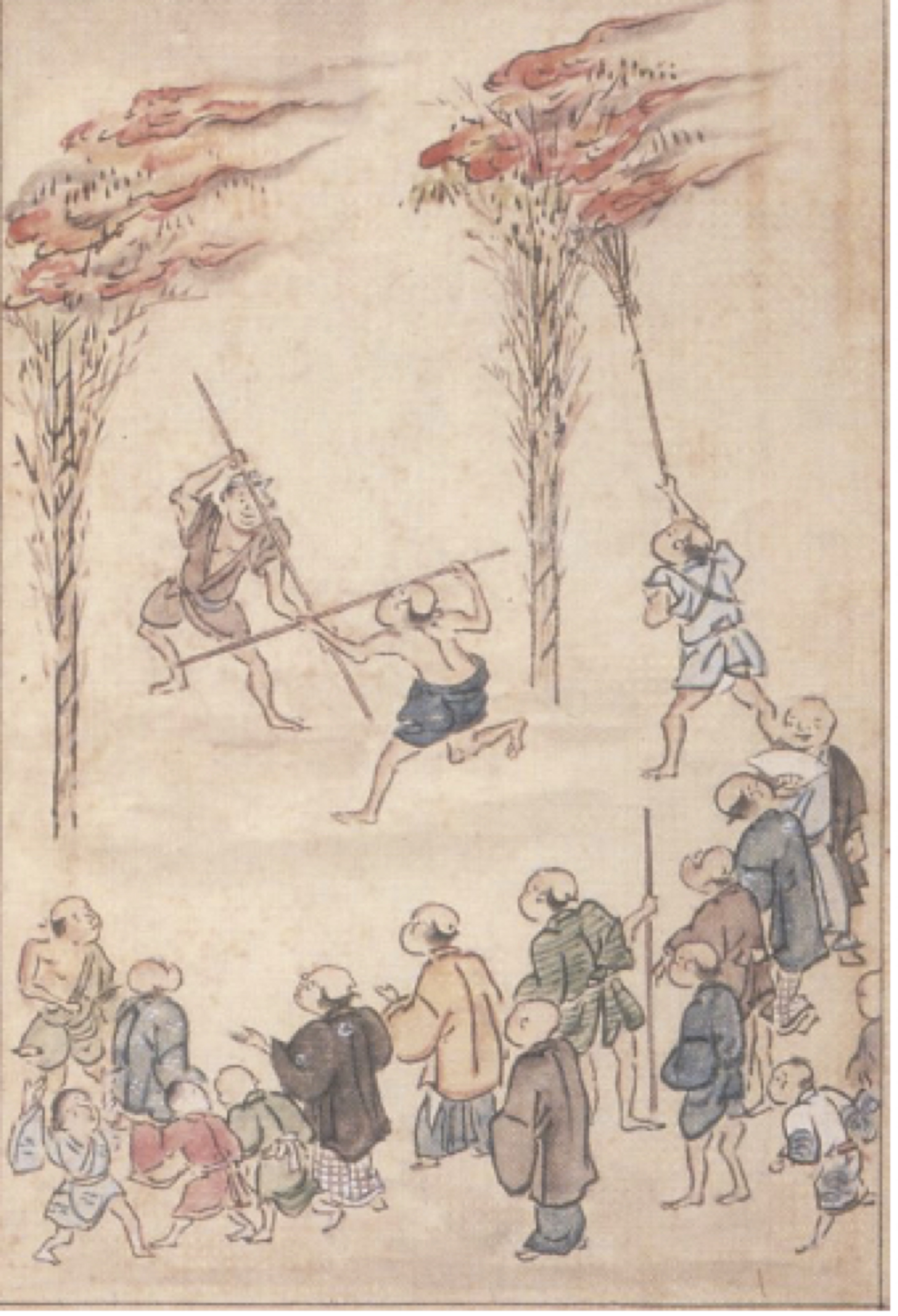
Bōnote (‘staff and hand’) is a festival-centered activity focused around small groups in the old Mikawa and Ryūsenji districts of Aichi. Collectively they hold numerous presentations at many local shrines and events in the surrounding areas, and have even flown overseas to demonstrate. For over 300 years, participants of bōnote have gathered at shrines to practice, organize and perform techniques with weapons as an offering to the ‘spirits of the altar,’ as well as parading new horses, and making offerings to ensure blessings and good fortune.

Bōnote was originally made up of groups called ryū or ryūha whose primary function was to teach prearranged training drills called kata to their members. The area where one lived decided which ryū each person belonged to, and the length of time spent performing, determined the ‘rank’ each person had, and what position they held in the group’s organization.

The kata of bōnote could be summed up as positioning, striking, and evading within set patterns. Going further, what is taught within those patterns is the number and frequency of striking; deflections, blocks and evasions; hand, leg, and body positions: all of which is accompanied by kakegoi (‘spirit yelling’).

A typical bōnote arsenal consists of (wooden sticks), yari (spears), uchigatana (disposable ‘side swords’), nagagama (war hooks), kama (sickles), naginata (glaives), and a host of others. Sticks are the primary training tool and a legitimate all-purpose substitute for the other weapons; they are what beginners start training with because authentic weapons are expensive and not something one wants to damage in training. Of course, they are also much safer.

Dueling with O-sensei, Chapter 20 – “Musubi: Tying Together or Tying in Knots”

 From the book Dueling with O-sensei: Grappling with the Myth of the Warrior-Sage

Musubi is a talismanic word in some aikidō circles. Its mundane definition is to tie things together. In aikidō, it is often linked with another term, awase (to link or blend together). For those with a romantic view of aikidō, this is imagined as a martial pas de deux in which, at the moment of contact, peace is established and two spirits blend together in harmony.

This was not the viewpoint of Ueshiba Morihei, however. To establish aiki was to impose order on chaos. Ueshiba’s oft-quoted formulation of man establishing harmony between heaven and earth made humanity, potentially, a cosmic force, reconciling disorder in any realm, be it that between people in conflict to the universe itself. Musubi and awase, therefore, imply blending and twining with another’s essence to move them in the direction that they should go.

What Would O-sensei Say?

Half a century ago, my parents took me a talk by Rabbi Abraham J. Twersky. Twersky was a descendent of the Chernobyl dynasty of Hasidic Rabbis. Over the decades I have seen the name Twersky elsewhere: always on attorney or doctor’s offices or on academic papers – beyond religion, they have been a dynasty of intellect. Rabbi Twersky, a psychiatrist, merged Mussar (Jewish ethics) with elements of the Twelve Step Program, becoming a profoundly important figure in the field of the treatment of substance abuse. Despite his incandescent intellect, he was a down-to-earth man, who worked with those suffering from addiction disorders from any walk of life, and who wrote books whose profundity was encased in simple accessible prose and images.

I do not remember the overall theme of his talk that evening, but part of it concerned his upbringing, which he told in the third person, in a charmingly lyrical Yiddish accent. “Twersky was a brilliant boy, a chess prodigy. He was crazy for chess, and would seize any moment to go and have a game. It became a kind of addiction. And one day, there was a chess tournament, and Twersky, only ten years old, had to go. Twersky had to go! He would be playing against much older boys, even adults, because chess is a game of intelligence, and winning and losing is based on the merits of the mind and the will. But it was the Sabbath, the most Holy day of the week, when G-d descends to earth to unite on that one day with the Sabbath bride, the Shekinah, the divine feminine presence of G-d. Think of that! G-d loved humanity so much that He exiled a portion of Himself so that creation could occur. It is on the Sabbath that G-d’s sacrifice is redeemed, that G-d in His Fullness is reunited. Our celebration of the Sabbath is in gratitude for G-d’s sacrifice for us. It’s that important!

Taryū Shiai & Other Oppositional Matches Within Japanese Martial Traditions

Historical accounts concerning  Japanese martial traditions often describe various forms of duels and other ‘oppositional matches.’ The further one goes back in history, the more remarkable these duels sound, but one must look at them with some degree of skepticism, the same way we should regarding stories of the American frontier where one or another hero ‘wrassled’ a grizzly bear or an alligator. For example, Araki Mataemon, a legendary master of Shinkage-ryū allegedly had a duel against thirty-six opponents—at least, that was the story in a Kabuki drama of the period. However, I recall a news article in Japan in the 1970’s, where an old document was found in a family’s storehouse (these kura, sometimes sealed up for centuries, have remarkable historical records and artifacts) that purported to be an eye-witness account of the duel. As best as I recall, Araki faced two enemies. The three of them faced off, swords clenched, trembling, unmoving for a L-O-N-G time. Eventually, one man’s nerve broke, and as he turned to run away, Araki cut him down. The other man ineptly attacked and Araki killed him too.

It is at this point that some definitions are in order, because there were a number of force-on-force encounters that individuals could engage, short of warfare or duels. In fact, most adversarial encounters with weaponry in the Edo period did not result in death, though it was always a possibility.

Guest Blog: Keeping It Real – by Chris LeBlanc

Very early on, Donn Draeger told me that these old traditions were and are vibrant ‘living entities.’  Not only are they worth preserving, saving, but they have significant vital lessons applicable to the fighting man of today’s world.  – Hunter Armstrong  (1)
Koryu is not only the actual martial techniques, but also the principles that underpin them, and, surprisingly many of these principles are absolutely relevant to modern times. – Ellis Amdur (2)
Therefore, teaching bujutsu in police academy is very effective way to influence the society.  I would say, you know, police need to posses their weapons, also they need to possess bujutsu as well. – Kurota Ichitarō  (3)

Two decades ago, I read an article in the Journal of Asian Martial Arts entitled “Striving for Realism: Concerns Common to Martial Arts and Law Enforcement Training.” The article discussed problems common to martial arts training and police defensive tactics in terms of ‘realism.’ It offered perspectives on key concepts in the classical martial tradition that converged with the training needs of law enforcement, and made the observation that “Inadequate training, unmindful of zanshin, will result in the reactive under- or over-estimation of circumstances and/or the perpetrator. Poor decision making based on exaggerated skills or impairment of technique due to self doubt confronts both the martial arts student and the LEO.” (4)  Twenty years later, we are all aware that little has changed.

The Curious Relationship Between Naginatajutsu & Kusarigamajutsu

When naginatajutsu was first taught as a specialty amongst Japanese weaponry is unknown. To start with, the claimed founding dates of almost all martial ryūha are dubious.  Many claim a founding date hundreds of years previous to their actual inception. This is not dishonesty; in earlier periods of Japanese history, lineage was as much a spiritual sense as it was historical data. Therefore, lineage records often mixed generations of non-practicing family members, teachers of other ryūha who influenced the development of one’s own, and famous warriors of the past whom the founder regarded as inspirations.

It is likely that the genuine founding dates of naginata-specialty ryūha was in the mid-Edo period. Yazawa Isaō, a 16th generation instructor of Toda-ha Bukō-ryū (now properly known as Tenshin Bukō-ryū) then at Nihon Joshi Daigaku, wrote in 1916 “It is not clear when naginatajutsu began to be taught as a single discipline. I have gone around to the few remaining martial arts instructors of the former domains of Japan, and examined the various military manuals they own. Upon reviewing these I discovered the oldest school of naginata is the Shizuka-ryū.”

Most of the schools she enumerated in her article are long extinct, but even a superficial consideration of remaining naginatajutsu schools will show something curious—many of them include the kusarigama (‘weighted chain and sickle) within their curricula; for example, this is true for Shizuka-ryū, Bukō-ryū, Tendōryū, and Jikishinkage-ryū. Given that the naginata-specialty schools became associated with women within a few generations of their creation (certainly by the late Edo-period), I have wondered at the association of these two weapons.

Martial Virtue Within Koryū Bugei

I wish to tease out the components that I have observed among those who were able to – and did – protect their training hall against dojo breakers or people who challenged them on the mat, striving to embarrass them or worse; those who handled taryujiai; and those who had or have a particular brilliance that has garnered them true respect, not only among other budōka, but among practitioners of other martial arts as well. I am making as clear a distinction as I can between the excellent  practitioner, whatever their rank, and true virtuosos. Were we talking about music, this would be a discussion about what makes Hélène Grimaud, Emil Gilels, Martha Argerich and Marc-André Hamelin incandescent musicians, rather than merely ‘excellent.’

Two objections may be raised to this essay, that what I discuss below does not encompass the complete martial art and training regimen of any koryū and it is at some variance to the way many authorities describe these arts today. My question here isn’t what makes one a comfortable participant in an idealistic martial art, or even a very dedicated student of a physically demanding, even dangerous discipline that has become a centerpiece of your life. My question is not what makes one a good teacher, a great leader of a dojo or someone who can apply the principles of budō in other social settings. My question is what makes one a virtuoso practitioner, regardless of one’s other qualities (and this include morality or spirituality).

NOTE: In it’s first iteration, this essay concerned aikidō. For Roots Still Cracking Rock, it was extensively revised to address concerns specific to koryū-bugei.

This essay is one of many that has been revised to make the writing itself more graceful, but more importantly, to incorporate my own developing perspective on this subject. It is now part of my new book, Roots Still Cracking Rock: Refections On My First Fifty Years Within Classical Japanese Martial Traditions, which in addition to revised essays from this site, contains new work as well. Below you will find a picture of the cover as well as a QR code to order a Special Edition of the book. In this group order of ten books or more, Ran Network will make a special print-run with a dedication on the title page to your dojo or other institution. 

The general release of the book on Amazon (equal in quality of the binding) will be on approximately April 20th.  I will place that link here as well when it is ready. 


Page 6 of 12

Powered by WordPress & Theme by Anders Norén