古現武道

KogenBudo

Martial Virtue Within Koryū Bugei

I wish to tease out the components that I have observed among those who were able to – and did – protect their training hall against dojo breakers or people who challenged them on the mat, striving to embarrass them or worse; those who handled taryujiai; and those who had or have a particular brilliance that has garnered them true respect, not only among other budōka, but among practitioners of other martial arts as well. I am making as clear a distinction as I can between the excellent  practitioner, whatever their rank, and true virtuosos. Were we talking about music, this would be a discussion about what makes Hélène Grimaud, Emil Gilels, Martha Argerich and Marc-André Hamelin incandescent musicians, rather than merely ‘excellent.’

Two objections may be raised to this essay, that what I discuss below does not encompass the complete martial art and training regimen of any koryū and it is at some variance to the way many authorities describe these arts today. My question here isn’t what makes one a comfortable participant in an idealistic martial art, or even a very dedicated student of a physically demanding, even dangerous discipline that has become a centerpiece of your life. My question is not what makes one a good teacher, a great leader of a dojo or someone who can apply the principles of budō in other social settings. My question is what makes one a virtuoso practitioner, regardless of one’s other qualities (and this include morality or spirituality).

NOTE: In it’s first iteration, this essay concerned aikidō. For Roots Still Cracking Rock, it was extensively revised to address concerns specific to koryū-bugei.

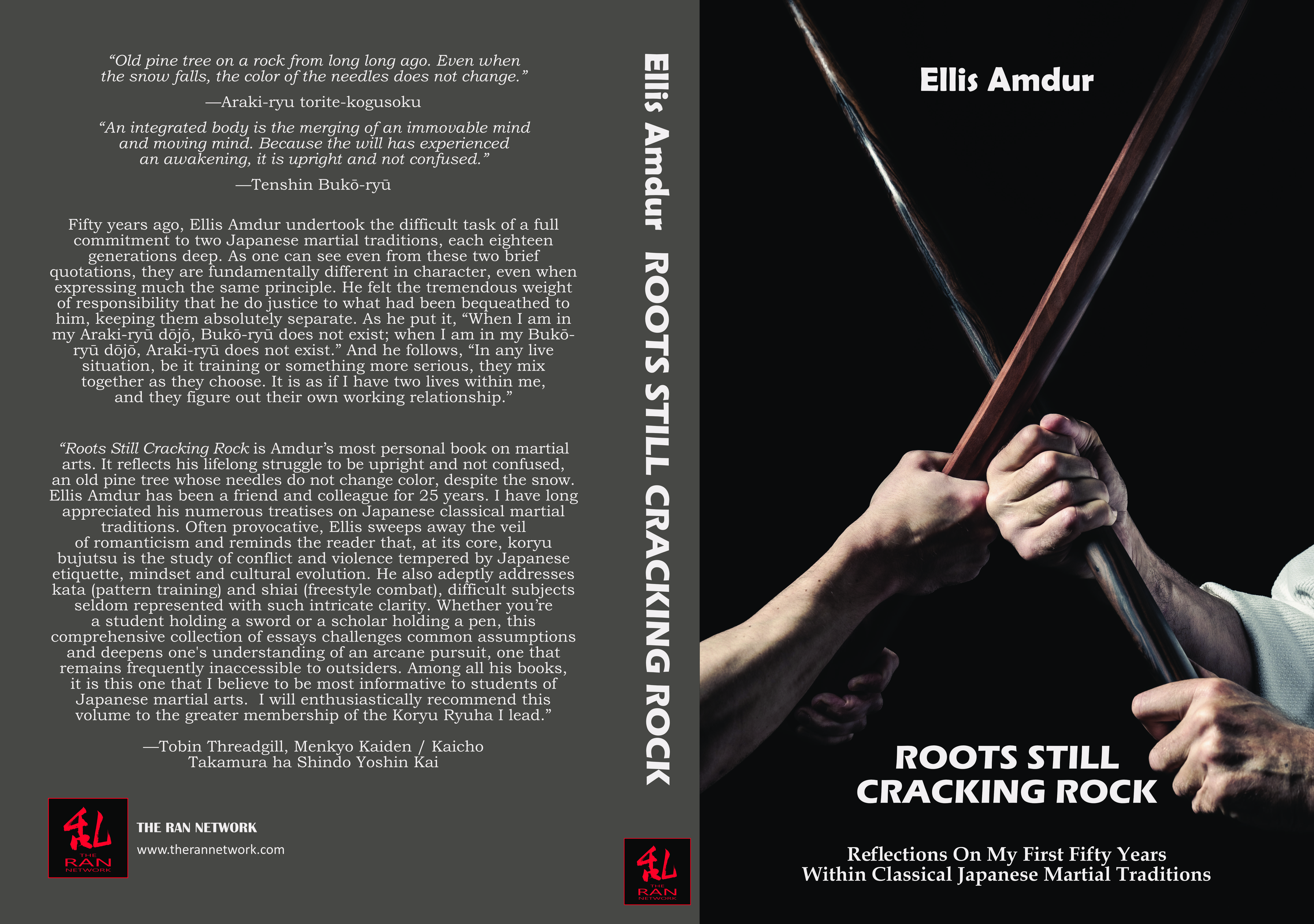
This essay is one of many that has been revised to make the writing itself more graceful, but more importantly, to incorporate my own developing perspective on this subject. It is now part of my new book, Roots Still Cracking Rock: Refections On My First Fifty Years Within Classical Japanese Martial Traditions, which in addition to revised essays from this site, contains new work as well.


Family Martial Arts: A Shadow Substrate Within Japanese Martial Traditions

It is conventional to think of Japanese martial traditions through the lens of the bugei, systems maintained by the warrior class. This is incorrect on a number of grounds. First of all, some venerable systems were founded and maintained by goshi (yeoman), a class of armed farmers who were (with few exceptions) at the very bottom of the warrior class. Rather than serve as retainers to a feudal lord, they were directly situated in the countryside, to some degree independent of domain politics, but more directly influencing (and influenced by) the lives of the peasants. Yes, they were nominally within the warrior class – but they were really apart from the mainstream of bushi culture. Beyond that, by the mid-Edo period, ever increasing numbers of non-bushi entered the majority of ryūha. In fact, in many ryūha, the majority of members were non-bushi, and others were led, even founded by those of the peasant or merchant class. (That they later might receive a bump up in rank by their feudal lord to become bushi does not change the fact that they were originally peasants or merchants).

Sparrow Wasp Stories

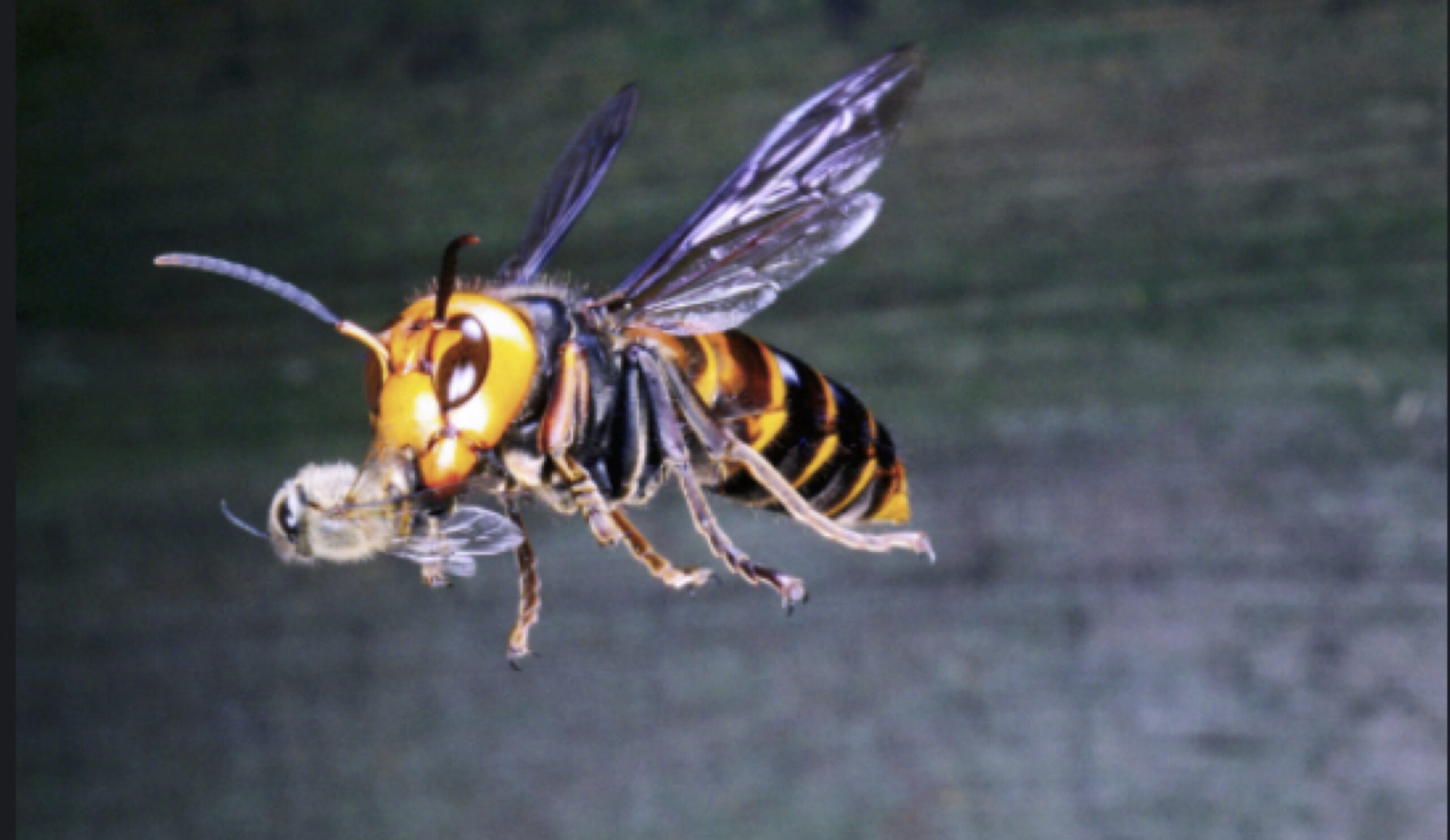
There is enormous hype in American media right now concerning vespa mandarina, known in Japan as susume-bachi, AKA ‘sparrow wasps.’ American media has made up a new name for them ‘Murder Hornets.’ I frequently saw them in parks and mountains in Japan–saw one once take down an enormous swallow-tail butterfly on the wing –  and I was one-degree of separation from a couple of marvelous events concerning them.

Esoteric Training in Classical Japanese Martial Arts

Kuji/juji is a specific ritual derived from  Shingon mikkyo, an esoteric sect of Buddhism, known as Mìzōng in China and Vajrayana in Tibet. This is an immense subject, but one way to think of such esoteric sects (mikkyo is a general term for esoteric practices) is they use ‘skillful means’ – any and every ritual that best fits a postulant to become enlightened in a single lifetime.

Shugendo is a syncretic Japanese religion, sometimes regarded as a ‘mountain cult.’ It is an amalgam of primordial Shinto and Taoist ritual practices (the latter, of course, derived from China) and esoteric Buddhism. It is associated with magic, and wonder-working, enacted by yamabushi, postulants who walk deep in the mountains, engaging in severe ascetic practices.  Among its lore is an association with nature’s elemental powers, known as tengu.

Warriors, too, used to go into temples and shrines in isolated forest and mountain areas to engage in ascetic training, and in the process, they utilized mikkyo rituals, sometimes those already present in their ryuha, and sometimes acquired through contact with such ascetics. The questioner refers to muga, a Buddhist term that is usually translated as ‘no-self.’ Or perhaps, the ‘that which is attached or identified with no thing in particular.’ However, whether such warriors were religious or not, their practice was for the purpose of accumulating power, not achieving ‘enlightenment.’ They were training in order to enhance their ability to survive, in order to better serve their lord. Most specifically, this was training in how to more effectively kill in combative engagements. They used mikkyo as a psycho-physical technology to enhance these capabilities.

Guest Blog: Antiques – by Dave Lowry

Probably only a minority of readers here will even recognise an electric typewriter, let alone have used one. In my high school and college years, however, the devices were something, technologically speaking, right up there between soft contact lenses and artificial hearts and not that far, in our imagination, below airborne automobiles. I covered reams of paper with electrically powered ink on my Smith-Corona for my schoolwork; its humming and the authoritative celerity of its clicking keys made me feel as if I was living in the 21st century.

My typewriter sat on a sewing table, one made in the early 19th century, of maple, with the yardstick markings imprinted along one edge, a table having been used, no doubt by tailors in early America, to turn out shirts worn by men who’d fought in the American Revolution. That table was in my bedroom not because I come from a wealthy family who furnished our home with classical, expensive antiques. Rather, my parents were collectors and dealers in Colonial era American furniture and decorative arts. So while some of the  antiques in our home stayed for a very long time, others came and went. Most importantly, however, my point is that “antiques” in my parent’s house did not connote objects that rested behind glass or that were never touched, never used at all. The silverware we ate with, the rugs on the floor, the clock on the mantel; all were a part of daily life for me.

Steal the Technique

Any modern sports science expert would cringe at the instructional methodology of classical traditions. The traditional method is often referred to as waza o nusumu (‘steal the technique’). It could also be termed, ‘learning by osmosis.’ An extreme example of this can be found in my recollection of account of a traditional Ainu midwife. She said that she attended births from the time she was a little girl. Her mother had her sit directly behind her throughout the entire birth. All she could see was her mother’s back. One day, when she was a teenager, without warning, her mother said, “You birth this one.” To repeat, she had never seen the birthing process itself, merely observed the movements of her mother’s back, shoulder and arms many hundreds of times. She stated that she simply reenacted those movements, which she had been doing in sympathy for most of her life as she observed her mother – the birth went smoothly and it was the beginning of the rest of her life.

Bowing

I recently noticed a question on a traditional Japanese martial arts discussion forum on Facebook: “Is there a proper way to bow?” And this was followed by a lot of sincere answers, most of which were wrong, or not-really-right, at least from the perspective of a traditional martial arts practitioner, where specific acts have specific meanings. In modern martial arts practice, on the other hand, there is often have a laissez-faire attitude, where a lot of things can be ‘good enough,’ based on the instructor’s arbitrary, often not culturally grounded practice. (This goes equally for Japanese and non-Japanese modern martial arts practitioners).

Publishing Books

Rather frequently, I get asked how I’ve published my books. I also get asked how I write my books. I’ll answer the latter first. Depending on the book:

  • I think of things and I write them down
  • I think about things, research them, think about them some more, and write them down
  • I imagine things and write them down
  • I sit with my fingers on the keyboard and think – I wonder what will happen today – and then something other than me writes them down.
  • What I never do is write an outline

OK, that’s taken care of. How did the manuscripts get from there to HERE?

Page 7 of 12

Powered by WordPress & Theme by Anders Norén