Jeffrey Mann wrote a response to my last post: “If I understand him correctly, he sees the reason for training in a koryu to be for the sake of the koryu itself, not the people in it or for the sake of historical archiving. However, our actions on behalf of an entity (like a nation) are usually for the sake of the people who live, or will live, in that entity. Doing something good for the entity itself, when it becomes the telos itself, seems misdirected. My contributions to a company, university, or nation are for the well being of its members and, hopefully by extension, the world. This seems to be the model of modern budo folks like Kano, Ueshiba, Doshin So, etc. This is more than pursuing the “Way” for myself alone. I don’t get what Amdur perceives to be the telos of the person who says, “I train for the ryu,” as he does.
What are the alternatives Mr. Mann offers to ‘training for the ryu?’ Let us first address ‘historical archiving.’ Without a doubt, this must be part of one’s involvement in any traditional martial art; otherwise, why train in culture specific, archaic combative methodology with weapons that will, perhaps, never be used again? However, to regard this to be the primary role of the ryu and its members, as exemplified in the phrase mukei bunkazai (‘intangible cultural treasure’), is problematic.
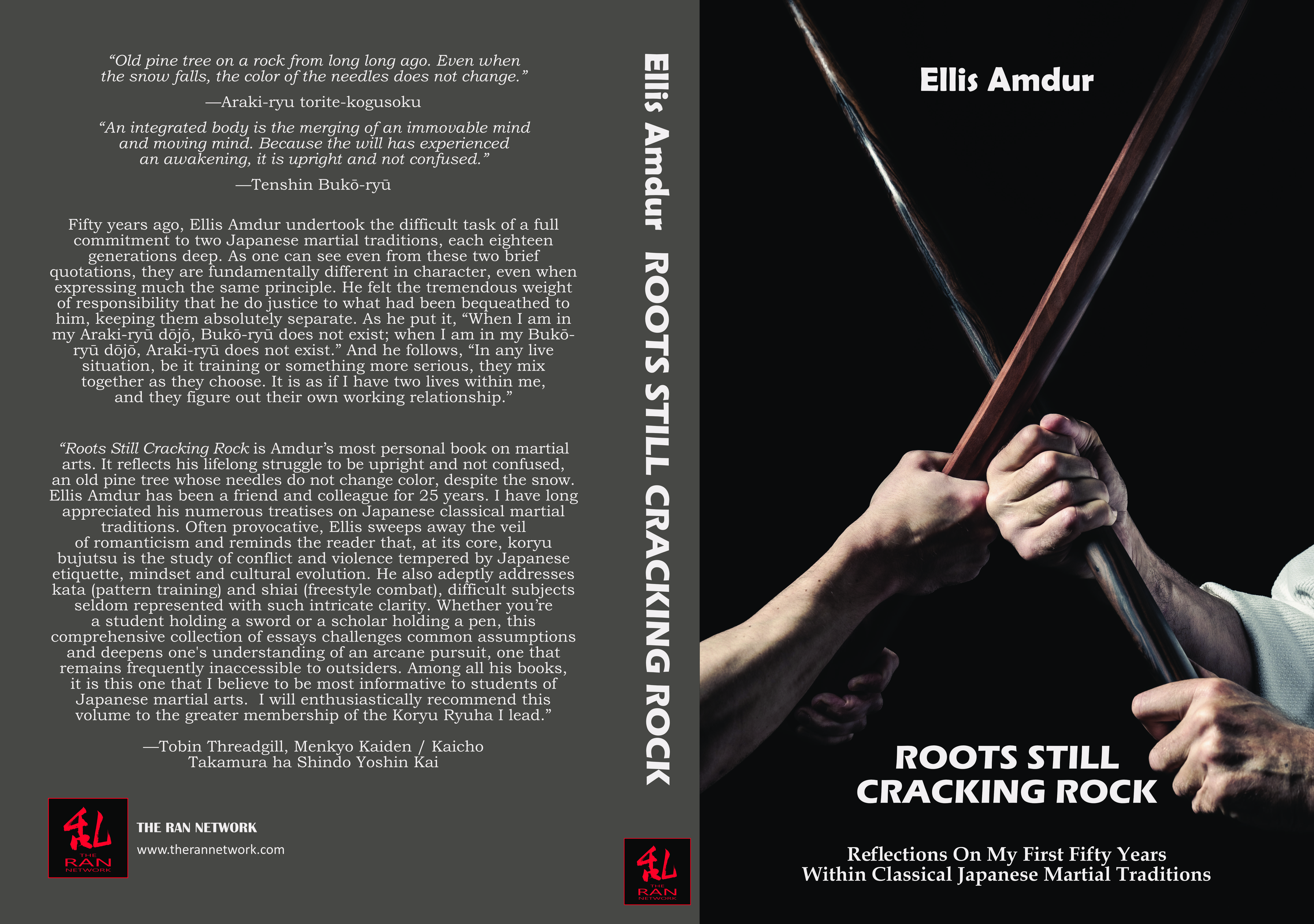
This essay is one of many that has been revised to make the writing itself more graceful, but more importantly, to incorporate my own developing perspective on this subject. It is now part of my new book, Roots Still Cracking Rock: Refections On My First Fifty Years Within Classical Japanese Martial Traditions, which in addition to revised essays from this site, contains new work as well.

Chris de Feijter
Great response, and I enjoyed reading the original article. Having been part of the “do”-circle for half of a century, I shifted to the “ryu”-circle quite some time ago. I find the ryu and its members the most awesome group I have come across ever in Budo. As a kaicho for two ryu, I find it important to choose members who will assist in further promoting, preserving and enjoying the ryu. Others cannot join. The dedication and effort within the ryu creates such a strong band and assists in further building a strong ryu.
Chris Bates
I agree with you, Ellis, and this was part of a long conversation with A-Han over coffee this afternoon. However I might propose a subtle variation to the reasoning.
In our school, we tend to think of this legacy as a meme in the original Richard Dawkins interpretation. That is, an idea/ pattern of behavior/pattern of movement that happens to enhance survivability and is passed down. Like genetic material, it can mutate/adapt to changing environments. Hence, it is neither devoid of a clear linkage to past Masters nor a calcified fossil that is unchanging. As Dawkins said, I think, the only true immortality we might enjoy is in the memes we leave behind. The linkage to the past master is not to enhance our reputation (the Ryu serving the present generation) but with the belief that through us the expression of the Master’s teachings continues to flow and as such he thus lives on. Of course, I am aware in writing this that flow is the meaning of Ryu. I train for the Ryu.
Ellis Amdur
That really nails my view of a ryu (contrary to many in the koryu world, certainly). It is a flow, not an institution. And to wax poetic (albeit poorly), one is required to respect the ‘banks’ of the stream, not necessarily every drop of water within it.
Chris Bates
As attributed to Heraclitus — ‘No man ever steps in the same river twice, for it’s not the same river and he’s not the same man.’