Throughout my career in martial art training, I would say that the majority of people I’ve met–my fellow students, my peers or acquaintances, are people who are happy to train with what they think is an exemplary teacher. For a number of reasons, however, (lack of drive, humility, reticence to push themselves forward .. . . .), they act as if they have an endless amount of time to learn the system.
That’s not so. Your teachers age, and as they do so, invariably, they cannot move as they once did. Some not only lose skill, but they lose knowledge. Others lose wisdom itself. Still others change: what seemed so important once is irrelevant to them as they approach, ever closer, to death, and their students’ mastery of their particular combative art no longer seems that important. In other words, their fire has burned out.
Some teachers continue to burn, training themselves rigorously even into old age, still discovering new aspects of their art. However, even if aspects of their art become more sophisticated and deep, there are often certain physical actions that they can no longer perform. Yet the student, quite naturally and sincerely, imitates the teacher, as they are now–particularly if they’ve no memory of him or her in earlier days. For example, when I first went to Japan and met Donn Draeger, he invited me to train in Shindo Muso-ryu. (it was, in a sense, the ‘entry level’ koryu for young people he was mentoring). There were a number of reasons I chose not to enter Shindo Muso-ryu or establish such a close relationship with Donn (I hadn’t travelled half-way around the world, giving up the life I knew, to land easily within the protective tutelage of someone who had been ‘there’ first…I wanted to find my own ‘there,’ different from his). In any event, the most important reason was watching Shimizu sensei, already old, shuffling his feet in 15 cm steps, and watching huge guys copying him, shuffling their feet and swinging their jo and sword much like their rotund elderly teacher.
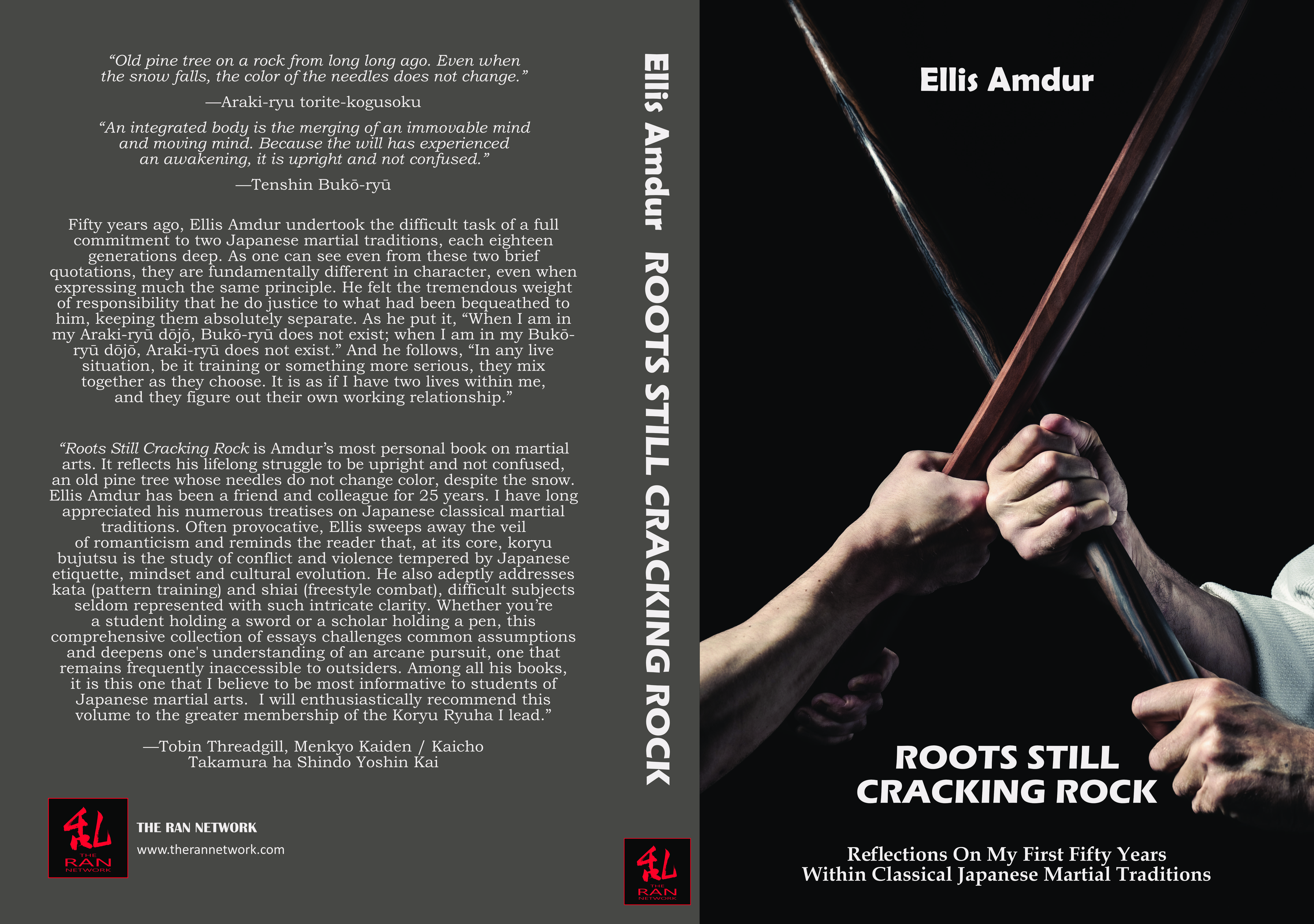
This essay is one of many that has been revised to make the writing itself more graceful, but more importantly, to incorporate my own developing perspective on this subject. It is now part of my new book, Roots Still Cracking Rock: Refections On My First Fifty Years Within Classical Japanese Martial Traditions, which in addition to revised essays from this site, contains new work as well. Below you will find a picture of the cover as well as a QR code to order a Special Edition of the book. In this group order of ten books or more, Ran Network will make a special print-run with a dedication on the title page to your dojo or other institution.
The general release of the book on Amazon (equal in quality of the binding) will be on approximately April 20th. I will place that link here as well when it is ready.

Chris de Feijter
Great article, fantastic truths. This applies to everything a person studies, even in elementary school.
Paul Fisher
Excellent. Thank you.
JJ Montes
A sobering article. Thank you.
Yannick
Once again, an enlightening point of view ! thanks for sharing !
Paul Norris
I mostly agree; “there’s limited time…”
Anytime I train with Dan Harden or solo train his lessons, I understand that “There is so little time that you (l) must act like there is NO time. You have to grab those moments and learn them: not only because you never know if your teacher will show or explain them again, but more importantly ( this is where I differ in importance), I must take ownership and chase what has been revealed through teaching or gleaned by observation. Otherwise, why do it at all? What’s the point?
Robert Gough
Thank you. My fellow Kung Fu students need this. I will share this truth with them.
Bill Fettes
Another thought-provoking article, sensei and, as well as the physical deterioration, there is also the declining memory faculties of the old masters to consider. I well remember contacting Pierre Simon at 70, still running the mountains and learning from the Yamabushi and, pushing into my 69th year, I have a jyodo gasshuku coming up to learn from different teachers and then am off to China to learn from my 5th Bagua teacher and 6th Xingyi teacher (the others have passed on). I had intended going to the U.S. as well, to upskill in various arts, until the intervention of my financial adviser. After 50 years in the Asian combative arts, I consider that any day I wake up and don’t learn something of value is a wasted day. And if I don’t put it into action or pass it on, more fool me!
Von Ryan
The experience (and mindset) of the “obsessed” martial artist is really well articulated and honestly written. I do often wonder however what the end goal is… especially as it is few if any who are capable or willing to attempt transmitting knowledge that is almost impossible to pass on. Is it a selfish internal pursuit, a therapy, a personal mental scaffold or is simply the pursuit of extrinsic value in devoting such resources to something that is so narrow in it’s scope or application?
Ellis Amdur
Beethoven could have confined himself to teaching young frauleins ‘The Moonlight Sonata,’ confining them to the first movement, which would be congenial with their abilities and their pretensions.
Why should a ballet dancer go on point? It hurts, it may damage her feet, and she could do the ‘skip-a-twirl’ hippie dance instead.
I watched my father bend wire for a cloisonne pendant, at least one hour until it was at the perfect curve.
One can always choose mediocrity. I am writing for those who do not.
Antonia Powers
Realistically, you can only “master” a martial art if you:
– have a body suited to the art
– start at a very young age (not as an adult)
– have good instruction
– have some decent training partners
– decide not to do much else with your life
For everyone else a martial art should add to your life, not be your life.
Ellis Amdur
Ms. Powers – Those are some very definitive statements, but most of them are incorrect. Some of the best practitioners I have ever seen a) started out unfit, ill or untalented b) some have started as adults. In fact, Mrs. Gao Fu started at age 58, and as she told me that at that age, she was so infirm that if she took a step forward and there was a snake under her feet, she wouldn’t have been able to stop herself from stepping on it 3) and 4) are obvious points – yes, you need a teacher and people to train with 5) Of course, one has to be very committed, but many of the finest practitioners have jobs, families lives. And as for your last pronouncement – it’s a perspective – one that a lot of people hold – but not necessarily true. You are taking the perspective of a person who uses martial arts as a hobby, not a way. And you assert that everyone else “should” have the same perspective as well. That’s fine – I don’t teach people like that – but that’s fine for them and whomever is interested in teaching them. The best practitioners, however, live their art whatever they are doing – it is not a hobby that they practice for a few hours a week or even a day. Because the hobby perspective is the death of traditional martial arts. Yes, not everyone can be a virtuoso pianist – but without virtuosos, all the greatest music is gone, because no one can play it – and if unheard, not only is it lost, but it is either devalued as a myth or no longer even imagined as possible.
Lex Opdam
How true. Excellent article. Thank you for your contribution.